Why Are Our Public Hospital Leaders Only Using Secret Illegal Meetings to Address the Peninsula Health Alliance?
By Commissioner Matt Ready
Jefferson County Public Hospital District No. 2
If someone told you your local public hospital might be secretly planning a major change—one that could shift control to a private nonprofit group—you’d probably expect open meetings, public discussion, and transparency, right?
But that’s not what happened.
Earlier this year, the CEO of Jefferson Healthcare submitted a major proposal to merge oversight of our hospital district with Olympic Medical Center. This proposal would create a new nonprofit corporation called the Peninsula Health Alliance with authority over both hospitals.
Here’s the problem:
There was no public vote. No financial review. No open discussion.
Instead, the proposal was quietly discussed behind closed doors in an executive session—a type of meeting only legal under very limited circumstances, like for real estate deals or pending litigation. This wasn’t that.
So I informed the board that our process was violating Washington’s Open Public Meetings Act (OPMA), blew the whistle to the public, and I filed a criminal complaint. The Jefferson County Sheriff investigated. A detective wrote a detailed report. The Chief Criminal Deputy Prosecutor reviewed it. Their conclusion? OPMA violations likely occurred—even if there wasn’t enough proof to press criminal charges.
That should have been a wake-up call.
Instead, hospital leadership is doubling down on secrecy.
Contents
Two Tries at Illegal Serial Meetings
First, in April after I raised my concerns and submitted the complaint, CEO Mike Glenn and board chair Jill Buhler arranged for each commissioner to meet privately for 30 minutes with a consultant named Karma Bass—who reports directly to him. These were unrecorded, one-on-one phone calls. No minutes. No public notice.
This is a textbook example of a serial meeting—when public officials avoid legal public meetings by holding one-on-one discussions behind the scenes. That’s illegal under OPMA. I refused to participate.
This is the response I sent to Karma:
Subject: Response to Interview Request
Hi Karma,
Thank you for your message. I need to respectfully decline the invitation for a private phone or audio interview related to the upcoming board retreat.
I have serious concerns about the confidentiality and legal implications of such a conversation, especially given your past role facilitating the 2019 board retreat. At that retreat, the board failed to reckon with the fact that a critical 2016 legal opinion—affirming a commissioner’s right to record public meetings—had been withheld from me and the public for years. I documented this entire episode in my book, Journey Through the Boardroom, including the moment during the retreat when I stated on the record that what Mike Glenn and Brad Berg had done could be considered fraud. Instead of allowing that conversation to continue, you intervened and asked, “Are you a lawyer?”—effectively shutting down the discussion. That moment could have opened the door to transparency and healing. Instead, it served to protect those in power and bury the issue.
Had we, as a board, learned then the importance of obtaining independent legal opinions and facing governance issues head-on, we might not be in the current crisis. When I recently asked for a second legal opinion regarding the Peninsula Health Alliance proposal, that request should have been honored immediately. Instead, the same pattern repeated: a lack of legal diversity, reliance on one voice, and suppression of commissioner oversight.
Given your involvement in both events—and the role you played in shaping the retreat’s outcome—I now view you as a potential material witness, and possibly a co-conspirator, in matters I have formally reported to legal authorities. For that reason, I cannot engage in any private or unrecorded conversations with you.
I remain open to your role in publicly noticed board meetings, properly convened executive sessions, or any forum governed by transparency and public accountability laws.
Sincerely,
Matt Ready
Commissioner, Jefferson County Public Hospital District No. 2
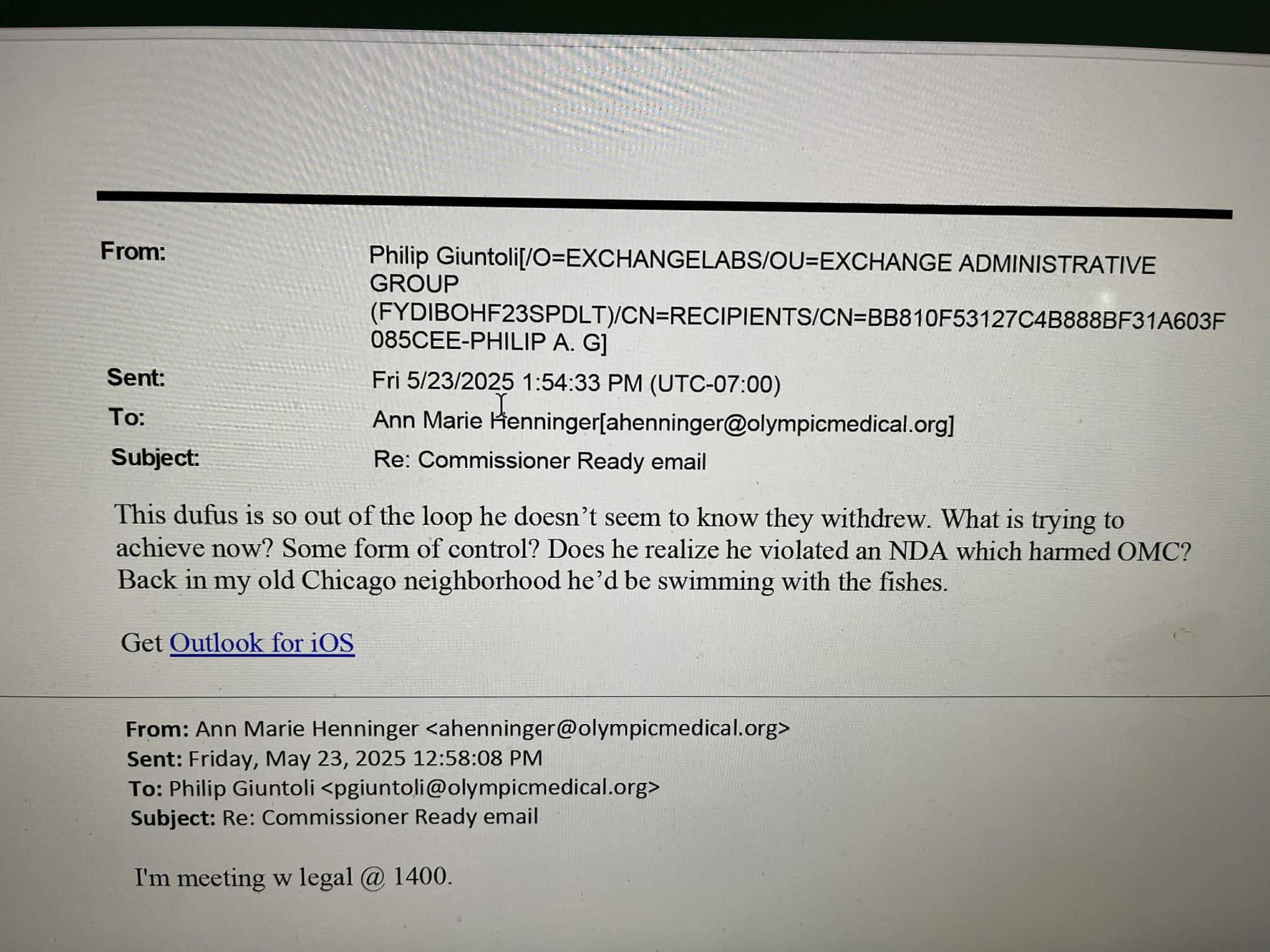
Second, on May 23, 2025, a Jefferson Healthcare Executive Assistant—acting under the CEO’s direction—emailed the board to schedule private one-hour meetings between each commissioner and an attorney from Ogden Murphy Wallace. Again, one-on-one, off the record. Again, I refused. This is what I wrote to all the commissioners in response:
Subject: Response to Interview Request – OPMA Concerns and Legal Process Integrity
Dear XXXXXXXX (executive assistant),
Thank you for your message. I am writing to formally respond to the request for a one-hour meeting between myself and legal counsel from Ogden Murphy Wallace PLLC (OMW), regarding matters tied to the Peninsula Health Alliance.
I decline to participate in such a meeting for the following reasons:
- OPMA Compliance Concerns:
A series of one-on-one private interviews between legal counsel and commissioners on a matter of active board deliberation creates a strong risk of violating the Washington State Open Public Meetings Act (OPMA). This resembles a “hub-and-spoke” serial meeting, a structure explicitly criticized by courts and the Attorney General as subverting open governance. As a public hospital district, we must not compound past OPMA concerns with further questionable practices.- Legal Representation Conflicts:
OMW’s retainer appears to have been initiated by the CEO without formal vote or direction from the full Board. If legal counsel is engaged to investigate matters where the CEO is a controlling central figure, the Board must secure legal representation that reports directly and solely to the full Board. Without that independence, the integrity and credibility of the process is compromised. If the goal is to understand what occurred in prior executive sessions, then Board Secretary notes or recordings (if any) should be reviewed before repeating private conversations under legal ambiguity.- Transparency and Documentation:
I am fully willing to correspond via email with legal counsel. If there are questions OMW wishes to ask me, I will respond in writing. This ensures everything is documented, accessible to all commissioners, and preserves transparency for the public and future record review. I encourage any such correspondence to be conducted openly and with full Board awareness.If legal counsel or the Board wishes to discuss these issues with me, I respectfully request it be done either in a lawful public meeting, a properly noticed executive session with all commissioners present, or through written email communication shared with the full Board.
Sincerely,
Commissioner Matt Ready
Jefferson County Public Hospital District No. 2
It remains unknown whether the other four commissioners took those meetings. If they did, it could constitute yet another serial meeting violation.
A Non Disclosure Agreement creates a conflict of interest with fiduciary responsibilities
Meanwhile, whenever members of the public asked about the Peninsula Health Alliance, the CEO and other commissioners claimed they were bound by a nondisclosure agreement (NDA). Yet this NDA was never voted on or approved by the full board—and to this day, as a sitting commissioner, I still don’t know who signed it, what it says, or even who it was signed with.
Signing an NDA in this context raises serious ethical and legal concerns. For a CEO or commissioner of a public hospital district to prioritize the secrecy of an NDA over their statutory fiduciary duty to the public may represent a profound conflict of interest. Public hospital officials are accountable first and foremost to the people—not to private consultants, corporate advisors, or secret deals. The public has a right to know what is being negotiated on their behalf. Silence protected by private agreements has no place in public governance.
A Pattern—and a Lawyer Reported to the Bar
These weren’t innocent mistakes. Jefferson Healthcare’s former attorney, Brad Berg, helped design and justify the strategy to keep these discussions hidden from the public using a stretched interpretation of the law.
Because of his role in advising and enabling these secret discussions, I filed a formal complaint with the Washington State Bar Association. His conduct was flagged in the Jefferson County Prosecutor’s report. Yet the Jefferson Healthcare board has made no public acknowledgment of any of this. Here is an excerpt from my Bar ethics complaint:
Mr. Berg’s legal opinion became the board majority’s shield against scrutiny, and his silence in response to formal concerns effectively blocked further inquiry. Since February 19, I have repeatedly submitted written legal concerns to the board and administration. Mr. Berg has not responded to these concerns directly, nor has he provided neutral legal analysis in any public setting.
Instead, his perceived authority has been used to discredit dissenting views and silence calls for transparency:
Commissioner Kolff: “Brad is the definitive person on this particular type of issue. He has actually written the code that we follow.”
Commissioner Buhler: “Our legal counsel… has said that nothing we have done is illegal… He is preeminent in this discussion.”This monopoly on legal interpretation has resulted in repeated efforts to mute me during meetings, block my motions from discussion, and falsely accuse me of slander and ethics violations when I attempted to inform the public.
What They’re Not Doing
They’re not addressing the sheriff’s findings.
They’re not holding public meetings to fix the damage.
They’re not apologizing to the voters.
Instead, they’re calling in lawyers and consultants—in secret—trying to isolate each elected commissioner, possibly coordinate their stories, and shape the outcome without any public accountability.
What Needs to Happen Now
To protect the public interest and begin restoring trust, I’m calling for:
1. A joint open public meeting
between Jefferson Healthcare and the OMC Board of Commissioners.
This is essential to stabilize, clarify, and legally define any current or future relationship between the two hospital districts.
2. A full internal investigation
by both Jefferson Healthcare and Olympic Medical Center into:
- What happened;
- Why it happened;
- How to prevent it in the future;
- And how to repair the damage, including a public apology for the deceptive process.
We can’t rebuild trust through silence.
We rebuild it through truth, accountability, and transparency.
Thank you for your time. Sincerely, Matt Ready
Image added 9/1/2026