 Matt Emails OMC and JHC Boards to clarify meaning of the Giuntoli “swimming with the fishes” email
From: Ready, Matthew <mready@jeffersonhealthcare.org>
Sent: Thursday, 03 September 2026 09:36:13
To:BoardAdmin@olympicmedical.org <BoardAdmin@olympicmedical.org>; pgiuntoli@olympicmedical.org <pgiuntoli@olympicmedical.org>; toblak@olympicmedical.org <toblak@olympicmedical.org>; thightower@olympicmedical.org <thightower@olympicmedical.org>; ksanders@olympicmedical.org <ksanders@olympicmedical.org>; gstephanz@olympicmedical.org <gstephanz@olympicmedical.org>; cbensen@olympicmedical.org <cbensen@olympicmedical.org>; nfield@olympicmedical.org <nfield@olympicmedical.org>
Cc: Commissioners <Commissioners@jeffersonhealthcare.org>
Subject: Request for clarification regarding Commissioner Giuntoli’s “swimming with the fishes” email
Dear Olympic Medical Center Board of Commissioners,
My name is Matthew Ready, and I am an elected commissioner of Jefferson County Public Hospital District No. 2, Jefferson Healthcare, in your neighboring county.
I am sending this communication to the commissioners of both public hospital districts and other relevant elected officials for informational purposes and to request an appropriate institutional response. I am not requesting or encouraging deliberation by email. Any board discussion should occur in a properly noticed meeting consistent with applicable law.
A person reviewing records relating to OMC’s Project Driftwood / Peninsula Health Alliance process provided me with the following email, which they obtained through a public records request:
From: Philip Giuntoli
Sent: Friday, May 23, 2025, 1:54 PM
To: Ann Marie Henninger
Subject: Re: Commissioner Ready email
“This dufus is so out of the loop he doesn’t seem to know they withdrew. What is trying to achieve now? Some form of control? Does he realize he violated an NDA which harmed OMC? Back in my old Chicago neighborhood he’d be swimming with the fishes.”
From: Ann Marie Henninger
Sent: Friday, May 23, 2025, 12:58 PM
To: Philip Giuntoli
Subject: Re: Commissioner Ready email
“I’m meeting w legal @ 1400.”
The email appears to refer to me. The phrase “swimming with the fishes” is commonly associated in American popular culture with organized-crime violence. I am not asserting that Commissioner Giuntoli intended a literal threat of physical harm, nor am I asserting that any criminal conduct occurred. I am requesting clarification regarding the meaning and context of the statement and OMC’s institutional response to it.
Please address the following questions:
- How does Commissioner Giuntoli, or alternatively OMC, explain the statement that, in his old Chicago neighborhood, I would be “swimming with the fishes”?
- Was the statement a joke, a figure of speech, an expression of anger or hostility, a reference to retaliation, or something else?
- Is OMC aware of any conduct, communication, or circumstance associated with this matter that would reasonably cause concern for my safety, the safety of my family, or the safety of Jefferson Healthcare personnel?
- Does OMC disavow threats of violence, intimidation, retaliation, or other improper conduct directed at any public official or participant in the Peninsula Health Alliance controversy?
- Has OMC reviewed this communication under any applicable commissioner conduct, ethics, civility, workplace safety, anti-retaliation, or governance policies? If so, please identify the applicable policy and describe OMC’s institutional response to the extent permitted by law.
- Does OMC consider this communication consistent with the standards of conduct it expects from its elected commissioners when discussing officials of neighboring public agencies or other elected officials?
Thank you for your prompt attention.
Sincerely,
Matthew Ready
Commissioner
Jefferson County Public Hospital District No. 2
Jefferson Healthcare
The Project Driftwood/ Peninsula Health Alliance Story updated master document and timeline
The below PDF is a copy of my updated master document collection of the entire Project Driftwood, Peninsula Health Alliance saga- with the latest revealed emails included appropriately in the timeline. (I know almost all images were broken in this conversion. sorry.)
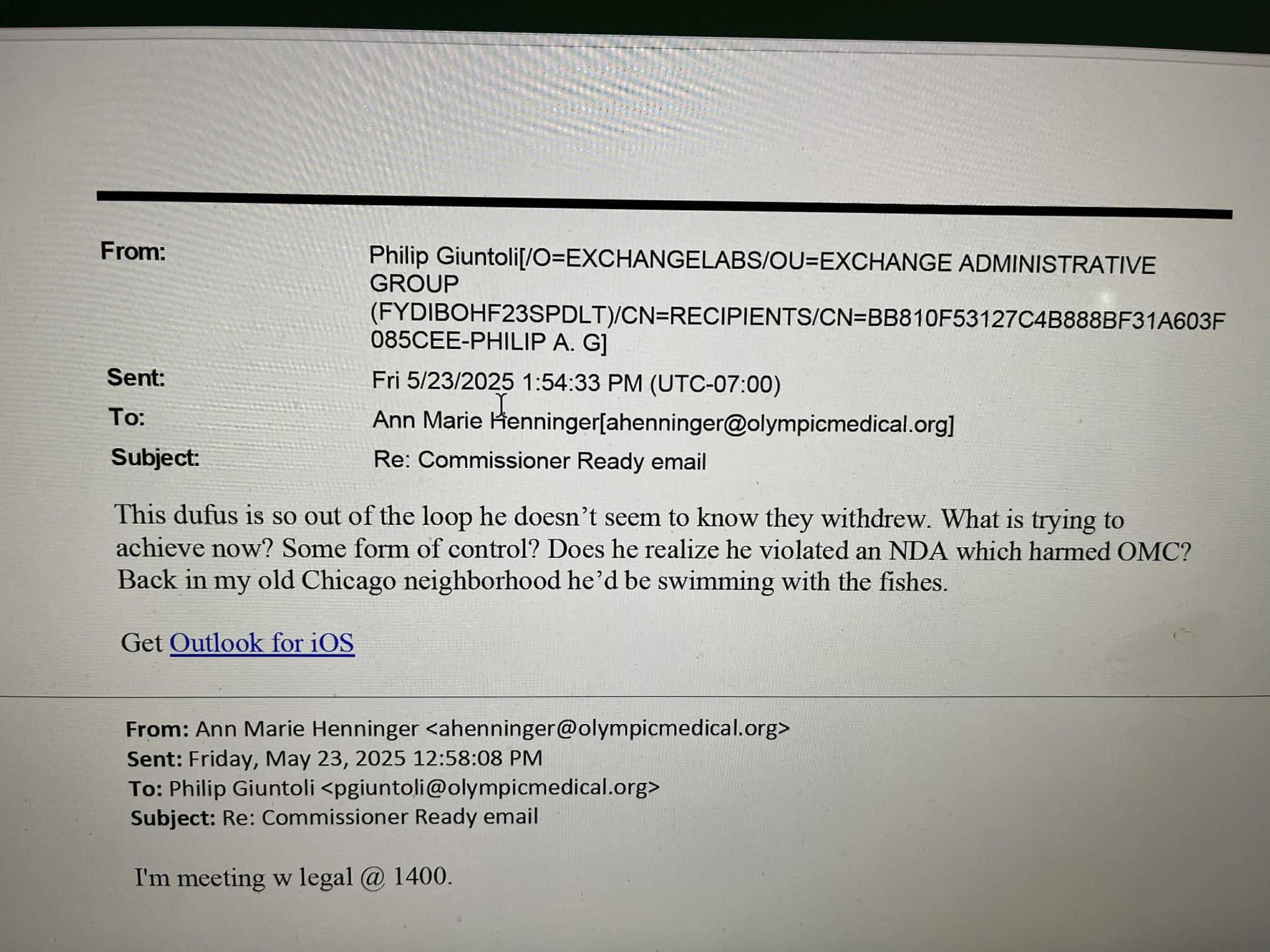
The above email was an internal email in reaction to the email I, Matt Ready, sent to all OMC and JHC commissioners on May 22. Here is that email:
05/22/2025 Matt Ready sends email to Olympic Medical Center board of commissioners and Jefferson Healthcare board notifying all of potential criminal liability exposure
Official Notice of Criminal Exposure Related to the Peninsula Health Alliance Proposal
Request for Joint Public Meeting and Internal Investigation
Commissioner Matt Ready Jefferson County Public Hospital District No. 2 mattready@gmail.com | (360) 477-1447 May 22, 2025
To:
Board of Commissioners, Olympic Medical Center Board of Commissioners, Jefferson County Public Hospital District No. 2 (Jefferson Healthcare)
Subject: Official Notice of Criminal Exposure Related to the Peninsula Health Alliance Proposal Request for Joint Public Meeting and Internal Investigation
Dear Commissioners,
This letter serves as a formal and urgent legal notice. Based on the available evidence, your collective roles in the development, submission, and concealment of the Peninsula Health Alliance proposal may constitute criminal violations of Washington State law, including RCW 9A.80.010 (Official Misconduct) and RCW 9A.28.040 (Criminal Conspiracy), as well as Open Public Meetings Act (RCW 42.30) violations. These are not theoretical risks—if proven, they carry maximum penalties of 364 days in jail and a $5,000 fine per count, along with civil liability and reputational harm to your institutions.
I. Basis for Criminal Exposure
The Peninsula Health Alliance proposal:
- Was submitted without a public board vote or legal authorization from Jefferson Healthcare;
- Was drafted and discussed in private, under a legally questionable executive session exemption;
- Was concealed from at least one commissioner during development;
- Was presented to Olympic Medical Center as an official act of Jefferson Healthcare;
- Was moved forward without public disclosure or open board deliberation.
The facts, preserved in internal emails, transcripts, and public statements, demonstrate that individuals within both institutions took actions that may meet the legal standard for official misconduct and conspiracy.
II. Criminal Intent Requires Knowledge—Not Malice
Under RCW 9A.80.010, a public servant commits official misconduct when they: “Knowingly perform an act which the public servant knows is unauthorized by law…”
This statute does not require malicious motive. It is enough that the act was taken knowingly, outside proper legal authority, and under the guise of public office. The Jefferson County Prosecutor’s refusal to pursue charges based on a lack of “intent to harm” is a misapplication of law. The legal threshold is clear, and the facts are already in the record.
III. Referral and External Investigation Underway
I have submitted notification and documentation of these potential crimes to:
- The Washington State Attorney General – Open Government Division
- The Jefferson County Sheriff and Prosecutor
- The Clallam County Sheriff
- Notification packets are also under preparation for federal authorities since these activities involve multiple jurisdictions.
IV. Demand for Immediate Internal Investigation
Whether or not external bodies act, I strongly urge both Jefferson Healthcare and Olympic Medical Center to:
- Immediately initiate a thorough internal investigation into the proposal’s creation, submission, and concealment; 2066_001.pdf
- Determine which individuals were involved, what internal policies were bypassed or ignored, and which governance safeguards failed;
- Remedy procedural or legal violations through formal internal review, retraining, and if necessary, corrective disciplinary action;
- Secure and preserve all documentation, communications, emails, drafts, and attorney correspondence related to the Peninsula Health Alliance;
- Prepare formal institutional responses and briefings for external agencies who may request cooperation.
Doing so is not only legally prudent—it is vital to preserving institutional credibility and rebuilding public trust.
V. Call for Immediate Joint Public Meeting
I further call on both boards to convene a joint open public meeting to:
- Disclose the full authorship, status, and legal justification for the proposal;
- Present findings from internal investigations;
- Receive public comment and answer questions;
- Consider formally rescinding and renouncing the proposal;
- Commit to future governance transparency.
This meeting must be fully noticed, recorded, and open to the public and press.
VI. Legal Counsel Must Report to the Board—Not the CEO
In my experience as a long-serving hospital commissioner, I have observed that legal counsel retained by public hospital districts often appear to view the CEO as their primary client and superior. These attorneys tend to defer to the CEO’s authority, advocate for the CEO’s positions, and protect the CEO’s legal interests as though the CEO were the equivalent of a private business owner. This structural bias presents a profound conflict of interest, particularly when allegations of misconduct or legal violations involving the CEO arise. For this reason, it is imperative that all public hospital district boards retain their own independent general counsel—separate from any attorney hired by or reporting to the CEO. This is the only effective way to establish a legal check and balance, safeguard the public interest, and ensure that the board receives unbiased advice aligned with its fiduciary and statutory obligations.
VII. Bar Complaint Against Legal Counsel
I also regretfully inform you that I have been forced to file a formal complaint with the Washington State Bar Association against Jefferson Healthcare’s legal counsel, Brad Berg. This step was necessary due to mounting concerns, supported by the county prosecutor’s own report, that Mr. Berg may have actively participated in or facilitated the concealment of critical legal risks and governance violations from the public and from the full Board of Commissioners. The prosecuting attorney explicitly flagged the potential complicity of legal counsel in suppressing transparency and helping executive leadership avoid legal scrutiny. In light of these findings, Jefferson Healthcare’s reliance on Mr. Berg’s legal advice must be viewed with caution by both boards until the matter is resolved through appropriate oversight. For the record, despite these concerns, the other Jefferson Healthcare commissioners continue to rely exclusively on Mr.Berg’s legal advice in this matter – in my opinion, a serious act of fiduciary negligence.
VIII. Notice
You are now officially on notice. Each day of inaction increases potential exposure—for individual commissioners, executives, and your institutions. You have the opportunity to take lawful corrective action now. I strongly encourage you to act quickly, transparently, and decisively.
Sincerely, Matt Ready Commissioner, Jefferson County Public Hospital District No. 2
The Peninsula Health Alliance Story
The video below explains the Peninsula Health Alliance story, the mistakes made, and my decision to blow the whistle on it. I hope you will watch and listen to it and make up your own mind. The video ends with my comments for why I am running for reelection to the board to continue serving the community’s interests. Thank you for taking the time to try to make the best decision possible when you vote. Sincerely, Matt Ready
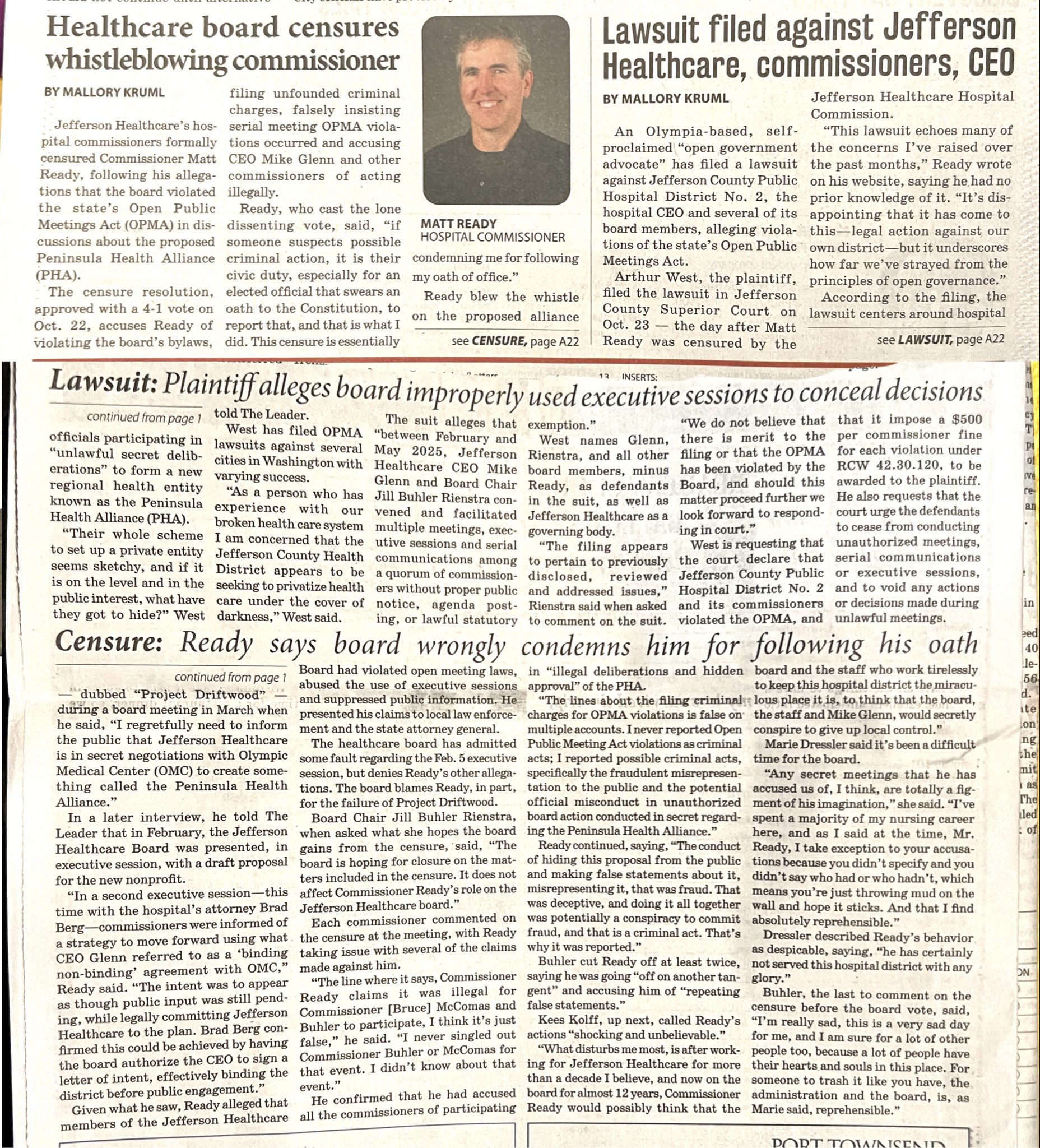
10/22/2025 PT Leader Publishes Op Ed from current Jefferson Healthcare Commissioner Kees Kolff on the Peninsula Health Alliance
10/22/2025 PT Leader Publishes Op Ed from Commissioner Kees Kolff on the Peninsula Health Alliance
I have known Stu’s opponent Matt Ready for many years. I voted for him when he first won a seat on the Board 12 years ago and he supported my campaign 2 years later. To his credit, he got the Board to start recording public meetings. In addition, he and I were the first to raise questions about one executive session last February 5th. Several attorneys later confirmed that the Board had “inadvertently” exceeded what was allowed under the Open Public Meetings Act (OPMA) real-estate exemption. We should have used the legal exemption with an attorney present. We publicly apologized for the error.
[Comment inserted by Matt Ready: “We should have used the legal exemption with an attorney present.” Careful readers might ask, “what does that mean? “we should have used the legal excemption for executive sessions, secret meetings, with an attorney present on Feb 5, so we could have LEGALLY held that executive session AND DISCUSS THE PENINSULA HEALTH ALLIANCE PROPOSAL IN DETAIL WITHOUT TELLING THE PUBLIC.” I want to be clear, this interpretation of Kollff’s public testimony above is exactly what I know the entire board and CEO believe- they believe if they had a lawyer present on Feb 5, then they could have never violated the OPMA and then keep the entire proposal hidden as they did. It was nice of them to say this on the record outside an executive session. ]
Matt went on to publicize inaccurate information from that meeting that he was not allowed to share. He has now completely destroyed his ability to work effectively on the Board because of his wide-ranging conspiracy theory.
I find it very hard to believe that anyone would accuse all the Board Members of Jefferson Healthcare (JHC), CEO Mike Glenn, and Mike’s entire top leadership team, of conspiring to give away local control of the healthcare system we work so hard to build and maintain. He reported us, and all of our counterparts at Olympic Medical Center (OMC), to the Sheriffs’ offices in both Jefferson and Clallam Counties for criminal activity. He claims that 3 attorneys from different firms, and our long-term professional board consultant Karma Bass, all violated the OPMA. There are too many unsubstantiated claims to list.
Some community members have raised questions about Matt’s conspiracy claims in regards to the Peninsula Health Alliance (PHA) proposal sent to OMC earlier this year. OMC had sent out a request for proposals. The PHA was our creative, non-binding proposal to have JHC and OMC collaborate more effectively in the future. It was crafted by Mike and his leadership team with major input from Commissioners Bruce McComas and Jill Buhler Rienstra, as allowed by the OPMA.
When Commissioners Marie Dressler, Matt Ready and I first learned of the PHA in February, I was concerned that the draft organizational chart in the proposal did not clearly show what was intended. To clarify my understanding, I sent my own org chart to the Board and our CEO the very next day. It showed and described the two Boards governing locally and independently, voluntarily and publicly sharing resources, services and collective purchasing through the PHA, a completely separate organization. Matt Ready and the other commissioners did not disagree with this interpretation, and Mike Glenn confirmed that it accurately depicted how the proposal would work, and not Matt Ready’s claim.
I was there in Sequim on March 28 when we presented the PHA proposal to OMC, and we emphasized the following:
• No merger or takeover was ever proposed.
• No financial bailout was involved.
• No loss of local control was contemplated.
• No negotiations would proceed without public involvement.
• The PHA Board would include all 7 OMC and 5 JHC Board members, with a voting mechanism to share power equally.
I described to OMC the problem we were having with Matt’s misinformation and conspiracy claims, and they were shocked. Mike had signed a non-disclosure agreement, which is standard practice and was required by OMC. We were one of 4 finalists in their selection process, but were dropped from consideration in part due to Matt’s behavior. He continues to insist it was a binding proposal, similar to a merger, that would have destroyed our local control and financial stability. [Matt Ready has never claimed the proposal presented on Feb 5 and then eventually submitted by Mike Glenn to OMC was a binding proposal. In fact, Matt wrote in his first public testimony in response to an inquiry from the PT Leader that Mike Glenn described in executive session with Attorney Brad Berg supporting him the concept of agreeing with OMC to a “binding non binding agreement” with OMC before going public. Celebrity attorney Brad Berg, a legend in the Washington State Hospital Association, then chimed in, “that (binding non binding agreement) can be accomplished by voting to permit the CEO mike glenn to sign a letter of intent”. ]
OMC has now signed a non-binding “Letter of Intent” to explore a partnership with the University of Washington. Their success is crucial to ours, since we share many patients. Given cuts in healthcare funding and proposed reductions in Medicaid, we may want to consider partnering in a larger peninsulawide alliance in the near future. As is customary when even public entities seek partnerships, public input comes after the initial, non-binding proposals have been submitted. All final decisions are made in public, after public input.
In this election we have a clear choice. Stu Kerber works for a small financial services firm he helped start, helping farmers in Eastern Washington work through generational transitions and financial problems. He built his career on relationships and knows how to manage conflicts professionally. As the father of 2 small children, he will bring a young parent’s perspective to the Board. We need challenging and different opinions on the board, but we also need collaboration. Stu Kerber will add both. The value of local control has and will always guide our Board, our CEO Mike Glen, and his leadership team in the future as we continue to expand the secular healthcare services this community needs.
NOTE: This opinion is mine alone and does not necessarily reflect the views of my fellow Board members.
“We should have used the legal exemption with an attorney present.“
“We should have used the legal exemption with an attorney present.“
“We should have used the legal exemption with an attorney present.“
Letter to the Commissioners from Vernon Lauridsen
Reprinted here with Vernon’s permission.
To: Commissioners Rienstra, McComas, Dressler, and Kolff
From: Vernon Lauridsen, 141 Pine Dr, Port Townsend, WA 98368
Re: Open Public Meetings
As a member of the public—and more particularly, a patient of Jefferson Healthcare—I think we deserve better. You are commissioners of a public entity. You took an oath swearing to adhere to the laws of Washington State. Certainly now the facts and law are clear. Are you so full of hubris and vindictiveness that you will not simply acknowledge your mistakes? Rather, your response is to attack the messenger. Censure him. Really, in this day and age?
The Open Public Meetings Act declares:
“Public agencies… exist to aid in the conduct of the people’s business. It is the intent of this chapter that their actions be taken openly and that their deliberations be conducted openly.”“The people of this state do not yield their sovereignty to the agencies that serve them. The people, in delegating authority, do not give their public servants the right to decide what is good for the people to know and what is not good for them to know. The people insist on remaining informed and informing the people’s public servants of their views so that they may retain control over the instruments they have created.”
(RCW 42.30.010)“All meetings of the governing body of a public agency shall be open and public…” (RCW 42.30.030).
A meeting takes place when a majority of the members of a governing body gather, either in the presence of one another or electronically, with the collective intent of transacting the official business of the public agency. A series of gatherings among less than a majority of the governing body that eventually turns into a majority qualifies as a meeting.
(Open Public Meetings Act, Municipal Research and Service Center, pages 6–7, July 2024).
Importantly, every member must complete training on the requirements of the Act within 90 days of taking their oath of office and at least once every four years thereafter (RCW 42.30.205). Ignorance or inadvertence is really not a viable excuse (online training is available through the MRSC). Members who attend meetings where action is taken in violation of the Act are subject to consequences. Violations, although not criminal, may result in a $500 monetary penalty (RCW 42.30.120).
But the critical consequence is that any ordinance, resolution, rule, order, or directive adopted in violation of the Act is simply null and void (RCW 42.30.060).
The events described in Commissioner Kolff’s opinion piece published in the October 22nd edition of The Leader constitute a meeting in violation of the Open Public Meetings Act. A proposal was drafted with the participation of a minority of the commissioners. The proposal was then distributed to the remaining members. Commissioner Kolff had concerns with the proposed organizational chart. He sent his own organizational chart to the entire board and CEO, which was then collectively discussed and agreed upon with the exception of one member.
You held a plainly illegal meeting in violation of the Open Public Meetings Act. The non-disclosure agreement signed by your CEO did not take precedence over state law. If that were the case, state law would be meaningless. Your effort to ratify the proposal through an admittedly illegally convened executive session grounded upon a “real estate purchase” exception hardly changes the outcome.
The whole process was folly from the outset. Olympic Medical Center’s demand for a non-disclosure agreement should have been a nonstarter. You were required to violate the Act in order to participate. Censuring the one commissioner who had the good sense to object just compounds the senselessness of the entire process.Vernon Lauridsen
cc: Matt Ready
Editor of The Leader
A Moment of Reckoning: Censure, Retaliation, and the Path to Transparency at Jefferson Healthcare
As I sit down to write this on October 24, 2025, I find myself reflecting on the events of the past few days with a heavy heart. Serving as a commissioner for Jefferson County Public Hospital District No. 2 has been one of the great privileges of my life, but it has also brought moments of profound disappointment. The actions of my fellow commissioners, our CEO Mike Glenn, and even the commissioners at Olympic Medical Center (OMC) have culminated in a series of decisions that prioritize secrecy over openness, loyalty to internal policies over adherence to the law, and retaliation over accountability. It’s disheartening to see public servants—people I respect and have worked alongside—choose paths that erode the trust our community places in us. Yet, amid this disappointment, I hold onto hope that the legal process now underway can serve as a catalyst for truth, healing, and a stronger foundation for Jefferson Healthcare and the people it serves.
Let me share the full context of what has transpired, starting with the board’s decision to censure me on October 22, 2025.
The Censure Resolution: A Step Backward for Accountability
On Wednesday evening, the Jefferson Healthcare Board of Commissioners voted 4-1 to pass Resolution 2025-26, officially censuring me for what they describe as violations of our Board Book’s Code of Conduct. I was the sole dissenting vote. The resolution accuses me of wrongly challenging the legality of certain actions related to the Peninsula Health Alliance (PHA) proposal—a non-binding plan to explore a partnership with OMC that would have created a new nonprofit governed by all 12 elected commissioners from both districts, inherently giving OMC a majority.
Here’s the full text of the resolution for transparency:
JEFFERSON COUNTY PUBLIC HOSPITAL DISTRICT NO. 2
RESOLUTION 2025-26
A RESOLUTION OF CENSURE BY THE JEFFERSON COUNTY PUBLIC HOSPITAL DISTRICT NO. 2 BOARD OF COMMISSIONERS OF COMMISSIONER MATT READY
WHEREAS, the Board of Commissioners finds that Commissioner Matt Ready is in violation of the Jefferson County Public Hospital District No. 2 Board Book; and
WHEREAS, the Board of Commissioners finds that Commissioner Ready has wrongly accused CEO Mike Glenn of illegal action regarding the Peninsula Health Alliance proposal despite the following rule contained in our Board Book bylaws which states:
“The Board retains ultimate responsibility for all actions and operations of the District, but grants all operational authority, per RCW 70.44.080, to the Board-appointed Hospital District Superintendent, also known as Administrator or Chief Executive Officer, hereafter referred to as the ‘CEO.’” ; and
WHEREAS, the Board of Commissioners finds that Commissioner Ready claims that it was illegal for Commissioners Bruce McComas and Jill Buhler Rienstra to participate in crafting the Peninsula Health Alliance with Mike Glenn and his leadership team, when this type of collaborative work is legal under the Open Public Meetings Act (OPMA) if it involves a minority of the Board members; and
WHEREAS, the Board of Commissioners finds that Commissioner Ready insisted that the District’s contracted professional consultant Karma Bass and an independent attorney Oskar Rey violated the Open Public Meetings Act by performing “serial meetings” while gathering input from individual members of the board in preparation for retreats and a legal opinion, even though attorneys at the state-funded Municipal Research and Services Center (MRSC), and an independent attorney confirmed that those actions were legal; and
WHEREAS, the Board of Commissioners finds that Commissioner Ready filed criminal charges with both Jefferson and Clallam County sheriffs and the Washington State Attorney General’s office against the Jefferson Healthcare and Olympic Medical Center boards, staff and attorneys involved in their RFP process for violations of the OPMA, despite the declaration within the 47 violations section of OPMA RCW 42.30.120 (3), which states, “A violation of this chapter does not constitute a crime…”; and
WHEREAS, the Board Book of Jefferson County Public Hospital District #2 serves as our bylaws and has a code of conduct section specifying among other things that:
“Commissioners will support the legitimacy and authority of the final determination or action of the Board on any matter, both publicly and privately, irrespective of the individual Commissioner’s personal position on the issue.”;
and WHEREAS the Board Book also states that: “Any action taken by a commissioner found in violation of any Board or District policies may subject the offending Commissioner to Board sanctions, including, but not limited to, official censure.”
NOW THEREFORE, BE IT RESOLVED THAT:
The undersigned Board of Commissioners feel obliged to and do officially censure Commissioner Matt Ready for his continued violation of the Code of Conduct specified in our Board Book
APPROVED this 22nd day of October 2025.
APPROVED BY THE COMMISSION:
Commission Chair Jill Buhler Rienstra: y_________________________________
Commission Secretary Marie Dressler: y_______________________________
Commissioner Bruce McComas: ___y_____________________________
Commissioner Kees Kolff: _____y________________________________
Commissioner Matt Ready: ___Nay_________________________________
This resolution, in my view, misrepresents the facts and elevates internal policy above state law. It disappoints me deeply that my colleagues would frame my efforts to uphold transparency as a breach of conduct, especially when independent legal reviews—including one commissioned by Jefferson Healthcare itself—have confirmed violations of the Open Public Meetings Act (OPMA). Reporting potential misconduct isn’t defiance; it’s fulfilling my oath of office.
My Response: Standing Firm for Transparency
The day after the censure, on October 23, 2025, I issued a press release to address these accusations directly. I believe it’s important for the community to hear my side unfiltered, so I’m including the full text here:
FOR IMMEDIATE RELEASE
October 23, 2025
Contact:
Matt Ready, Hospital Commissioner
📧 readyforhealthcare@gmail.com
🌐 www.ReadyForHealthcare.org
Jefferson Healthcare Board Censures Whistleblower Commissioner Matt Ready
Summary for Editors:
Jefferson Healthcare Commissioner Matt Ready was formally censured by a 4–1 board vote Wednesday night. He contends the resolution contains multiple false statements, asserts that corporate loyalty supersedes the law, and represents retaliation for his efforts to expose violations of Washington’s Open Public Meetings Act and to report potential criminal conduct to authorities.
On October 22, 2025, the Jefferson County Public Hospital District #2 Board of Commissioners voted 4–1 to censure Commissioner Matt Ready, who cast the lone dissenting vote.
The resolution accuses Ready of violating the board’s Code of Conduct for publicly criticizing the board and for reporting potential violations of Washington’s Open Public Meetings Act (OPMA) and possible criminal conduct to authorities.
Commissioner Ready responded:
“This censure isn’t about professionalism—it’s about punishing transparency.
I will never agree that loyalty to the board outweighs loyalty to the people and the law.”
Background
The dispute stems from the Peninsula Health Alliance (PHA) proposal—a non-binding plan created by Jefferson Healthcare CEO Mike Glenn and two commissioners to explore partnership with Olympic Medical Center (OMC).
The document proposed a new nonprofit governed by all 12 elected commissioners—seven from OMC and five from Jefferson Healthcare. It contained no alternate or “equal-voting” formula, giving OMC an inherent majority.
The proposal was first presented to the Jefferson board in an executive session on February 5, 2025, labeled under the “real-estate” exemption of the OPMA.
According to a confidential legal review by Ogden Murphy Wallace PLLC, commissioned by Jefferson Healthcare itself, this session violated the OPMA because it discussed matters unrelated to real estate. An independent attorney, Austin Hatcher, reached the same conclusion.
Ready further contends the board conducted an illegal straw poll during the February 5 executive session, effectively approving the submission of the proposal to OMC outside a lawful public meeting.
He also alleges that the CEO and several commissioners made false or misleading statements to the public regarding the proposal in an effort to conceal its existence—actions he reported to law enforcement as possible acts of fraud.
Ready’s Position
“The district’s own lawyers confirmed the February 5 meeting violated the Open Public Meetings Act,” Ready said.
“Rather than conduct a professional root-cause analysis and correct course, the majority has chosen to censure the one commissioner who insisted on following the law.”
Ready denies claims in the resolution that he attempted to file OPMA violations as criminal charges. He clarifies that his reports to the Jefferson and Clallam County sheriffs alleged potential fraud and official misconduct by leadership—not staff—and that reporting potential criminal acts is part of a commissioner’s oath of office.
He adds that denying the existence of the Peninsula Health Alliance proposal and claiming the February 5 executive session concerned real estate were false statements that warranted investigation as possible criminal fraud, a felony.
Also, approving or advancing the proposal during executive session constituted unauthorized board action and potentially official misconduct, a gross misdemeanor under state law.
Code of Conduct Questioned
The censure cites a Jefferson Healthcare policy requiring commissioners to “support the legitimacy and authority” of all board actions, even when they disagree.
Ready calls that interpretation unethical and unconstitutional:
“No public official is obligated to support the legitimacy of an illegal act.
My oath of office to defend the Constitution supersedes any corporate policy.
The people of Washington did not give public servants the right to decide what’s good for them to know and what isn’t. The Open Public Meetings Act exists to stop exactly this kind of secrecy.”
Broader Implications
The censure follows months of public controversy since Ready revealed the Peninsula Health Alliance proposal in March 2025—prompting front-page coverage in the Port Townsend Leader and multiple independent legal reviews.
Ready contends the censure constitutes retaliation against a whistleblower, an act explicitly prohibited under Washington law.
“The board majority has spent a year denying wrongdoing instead of confronting the illegal secrecy that started all this,” Ready said.
“Tonight’s censure confirms their commitment to retaliation over transparency, learning, and genuine reform.”
Closing Statement
“I’ve tried to serve this community with honesty and transparency.
It’s surreal to watch colleagues argue that seven equals five and secrecy equals openness.
The voters will soon decide whether they want a hospital board that values accountability, openness, and lawful process.
If I’m reelected, I’ll keep fighting for transparent, responsible governance.
If not, I’ll leave grateful for the chance to serve—and confident that truth eventually prevails.”
For Full Context and Public Record
Commissioner Ready maintains a full archive of 11 years of blogs, meeting videos, and public records, including video of the October 22, 2025 meeting where this censure was discussed and passed, available at:
👉 www.ReadyForHealthcare.org
Background Links
🎥 Video: The Peninsula Health Alliance Story
https://youtu.be/5MzIY0g1XoY?si=fqF8tA_HJ7Ud9R30
🎥 Video: Public Meeting—Jefferson Healthcare Board Discusses and Passes the Censure Resolution
https://youtu.be/50atzlro_RQ?si=8NslPRv1sNaB9zDw
📄 Document: Peninsula Health Alliance Proposal (PDF)
This statement reflects the views of Commissioner Matt Ready and is provided as a matter of public record and transparency.
Full Text of the Censure Resolution
(Reprinted for transparency and public access.)
In sharing this, I want to emphasize my disappointment—not in disagreement itself, which is healthy in any board—but in the choice to punish calls for transparency rather than address the underlying issues.
The OPMA Lawsuit: Perhaps A Necessary Step Toward Truth
Adding to this unfolding story, on October 23, 2025—the same day as my press release—community advocate Arthur West filed a lawsuit in Jefferson County Superior Court against Jefferson Healthcare, several commissioners, and CEO Mike Glenn. The complaint alleges multiple violations of the OPMA related to the handling of the PHA proposal, including unlawful executive sessions, serial meetings, and misuse of exemptions. I had no idea such a lawsuit was coming.
For the sake of completeness, here’s the key content from the complaint. (Note, the lawsuit misnames some of the commissioners of Jefferson Healthcare, an oversight I am sure they will correct.): Direct link to pdf (link)
IN THE SUPERIOR COURT OF THE STATE OF WASHINGTON
FOR JEFFERSON COUNTY
Arthur West,
Plaintiff,
v.
Jefferson County Public Hospital District No. 2, d/b/a Jefferson Healthcare;
Jill Buhler-Rienstra, Board Chair; Bruce MacFarlane, Commissioner; Kees Kolff, Commissioner; Teresa Bradley, Commissioner; Thomas O’Brien, Commissioner; and Mike Glenn, CEO,
Defendants.
PLAINTIFF’S ORIGINAL COMPLAINT
I. INTRODUCTION
1.1 This is an action under RCW 42.30, the Open Public Meetings Act (“OPMA”), arising from unlawful secret deliberations by Jefferson County Public Hospital District No. 2 (“Jefferson Healthcare”) and its governing board concerning creation of a private nonprofit entity known as the Peninsula Health Alliance (“PHA”), intended to merge or coordinate governance with Olympic Medical Center (“OMC”).
1.2 Between February and May 2025, Jefferson Healthcare CEO Mike Glenn and Board Chair Jill Buhler-Rienstra convened and facilitated multiple meetings, executive sessions, and serial communications among a quorum of commissioners without proper public notice, agenda posting, or lawful statutory exemption.
1.3 Plaintiff seeks declaratory and injunctive relief, statutory penalties against the governing-body members, and such further equitable remedies as may be just.
II. PARTIES AND JURISDICTION
2.1 Plaintiff Arthur West is “any person” within the meaning of RCW 42.30.130, and resides in Olympia, Washington.
2.2 Defendant Jefferson County Public Hospital District No. 2 (“Jefferson Healthcare”) is a public hospital district and “public agency” under RCW 42.30.020(1)(a).
2.3 Defendants Jill Buhler-Rienstra, Kees Kolff, Bruce MacFarlane, Teresa Bradley, and Thomas O’Brien are elected commissioners and members of the governing body of Jefferson Healthcare, subject to RCW 42.30.
2.4 Defendant Mike Glenn is the appointed Chief Executive Officer of Jefferson Healthcare. He is not a member of the governing body but is named as a non-member participant who knowingly facilitated or directed acts violating the OPMA. Plaintiff seeks declaratory and injunctive relief against him under RCW 42.30.050 and .060 but does not seek personal penalties under RCW 42.30.120.
2.5 Jurisdiction and venue are proper in Jefferson County Superior Court under RCW 4.12.025 and RCW 42.30.120.
III. ALLEGATIONS
3.1 On or about February 5, 2025, Jefferson Healthcare commissioners met in executive session to discuss the Peninsula Health Alliance proposal. No valid exemption under RCW 42.30.110 applied, as no pending litigation, specific threatened litigation, or real-estate transaction existed.
3.2 March 26, 2025 Board Meeting (“Project Driftwood”) – During this meeting, Commissioner Matt Ready attempted to raise concerns regarding undisclosed negotiations with OMC. Chair Buhler-Rienstra silenced discussion and adjourned into executive session under purported “legal advice” grounds. Emails later disclosed show that drafts of the merger proposal were circulated privately among a subset of commissioners and Jefferson Healthcare’s counsel, Brad Berg.
3.3 April 2025 Serial Meetings – After Ready’s objections, CEO Glenn and Chair Buhler-Rienstra arranged one-on-one, unrecorded telephone meetings between consultant Karma Bass and each commissioner regarding the merger. These meetings were un-noticed, undocumented, and occurred outside public view. Such “hub-and-spoke” communications constitute unlawful serial meetings under Wood v. Battle Ground Sch. Dist. No. 119, 107 Wn. App. 550 (2001), and Egan v. City of Seattle, 173 Wn. App. 492 (2013).
3.4 May 23, 2025 Meetings with Legal Counsel – An executive assistant, acting under CEO Glenn’s direction, scheduled private one-hour meetings between each commissioner and attorneys from Ogden Murphy Wallace PLLC concerning the alliance. These separate, sequential interviews again constituted a prohibited serial meeting.
3.5 Non-Disclosure Agreement – Commissioners and staff represented to the public that discussions were bound by an NDA that was never approved or voted upon by the full board. Even fellow commissioners were denied access to the document. Use of such an NDA is incompatible with the fiduciary obligations of public officers and violates the public-access policy of RCW 42.30.010. Approval of the NDA by the Board appears to have been accomplished in violation of the OPMA.
3.6 Independent Legal Opinion – On May 23, 2025, journalist Alison Arthur obtained an opinion from attorney Michele Earl-Hubbard of Allied Law Group, confirming that no exemption under RCW 42.30.110 authorized any executive session to discuss alliances or mergers. Her conclusion:
“No, the agency absolutely cannot legally use the ‘real estate’ or ‘potential litigation’ executive-session grounds to discuss creation of this new entity… So no — they are breaking the law meeting in secret under either of those two exemptions.”
3.7 Sheriff’s Investigation – Detective Sergeant Derek Allen of the Jefferson County Sheriff’s Office investigated and reported:
“The actions likely violate the OPMA and may constitute official misconduct if intent is proven.”
The report was transmitted to the Jefferson and Clallam County Sheriffs, the State Auditor, and the Washington Attorney General’s Office.
3.8 Despite these findings, the board has neither rescinded the NDA nor conducted any public review of the Peninsula Health Alliance plan.
IV. CAUSES OF ACTION
4.1 Violation of the Open Public Meetings Act (RCW 42.30)
Defendants held one or more meetings in violation of the OPMA by:
- Conducting secret deliberations and serial meetings;
- Using false statutory exemptions;
- Approving or ratifying actions outside public session;
- Failing to provide proper notice or maintain minutes.
4.2 Declaratory and Injunctive Relief (RCW 42.30.130)
Plaintiff is entitled to declaratory judgment that these actions violated the OPMA and to injunctive relief restraining future violations.
4.3 Civil Penalties (RCW 42.30.120)
Each member of the governing body who knowingly attended a meeting where action was taken in violation of the OPMA is personally liable for a $500 penalty for the first violation and $1,000 for each subsequent violation.
4.4 Attorney Fees and Costs (RCW 42.30.120(4))
As the prevailing party, plaintiff is entitled to recover reasonable attorney’s fees and all costs of suit.
V. PRAYER FOR RELIEF
Plaintiff Arthur West respectfully requests that this Court:
- Declare that Jefferson County Public Hospital District No. 2 and its board violated the Open Public Meetings Act;
- Enjoin defendants from further violations of RCW 42.30;
- Impose statutory civil penalties on the individual commissioners;
- Award plaintiff his costs and reasonable attorney’s fees; and
- Grant such further equitable or legal relief as the Court deems just and proper.
Dated: [undated in provided copy]
Respectfully submitted,
Arthur West
120 State Ave. NE #1497
Olympia, WA 98501
Pro Se Plaintiff
This lawsuit echoes many of the concerns I’ve raised over the past months. It’s disappointing that it has come to this—legal action against our own district—but it underscores how far we’ve strayed from the principles of open governance. The involvement of OMC commissioners in the PHA discussions without proper transparency only compounds the issue, as it affects communities across the peninsula.
Looking Forward: Hope in the Pursuit of Truth
As we navigate this challenging chapter, I remain hopeful. A legal process like this lawsuit can be cathartic, forcing us to confront uncomfortable truths through evidence and impartial review. It offers a chance for Jefferson Healthcare to rebuild on a foundation of genuine accountability, where decisions are made in the light of day, and where loyalty to the law and our community comes first. For the residents who depend on us—patients, staff, and families—this could mark the beginning of a more transparent, resilient institution.
I invite you to review the full archives on my website, www.ReadyForHealthcare.org, including videos and documents linked in the press release. Your thoughts and feedback are always welcome; together, we can advocate for the healthcare system our community deserves.
With respect and optimism,
Matt Ready
Jefferson Healthcare Commissioner
Why I’m Running Again for Hospital Commissioner
Below is the speech I gave the other night to the Indivisible Port Townsend group at the Jefferson County Fairgrounds. Please reach out to me with comments, questions, requests for signs, or to arrange a meetup.
Hi, I am Matt Ready. I’ve served as one of your elected public hospital commissioners for eleven years. Before that, I worked at Jefferson Healthcare in Information Systems and Performance Improvement, helping our teams build systems and processes that support patient care. I am married to Stacey Larsen, a long time farm to school advocate and leader in our community. I have also dabbled over the years as the JV and Varsity volleyball coach at Port Townsend High School.
I care about our community, and I care deeply about freedom, equality, civil rights, and democracy. I believe truth and transparency are the foundation of a healthy society. Jefferson Healthcare is not just a hospital—it is a public institution, part of our government of, by, and for the people.
When I first ran, it was as an activist. I wanted to push for creative ways to ensure everyone in our community has access to care and to advocate for single-payer healthcare. Once on the board, I embraced both the advocacy and the everyday work of a commissioner: monitoring high level metrics and contributing to thoughtful deliberations on major decisions of the district.
As commissioner I challenged the board to improve the quality of our deliberations, to have the integrity to do what we claim we do in our board policies, and to commit our district to the health of our community.
Along the way, I’ve been at the center of two major governance controversies—each about transparency and the public’s right to know.
The Recording Fiasco
The first major controversy began when I decided to record our board meetings so there would be a complete and accurate record of everything said in public session. After only a couple of months on the board, I could see it was needed.
At that time—before commissioners Kolff or McComas joined—the CEO and other commissioners aggressively opposed the recording of meetings. To make a long story short, It took nine years from the first confrontation to get the clear legal truth: both commissioners and citizens have the absolute right to record open meetings. And this was resolved when the CEO produced a written legal opinion that had been in his possession for 5 full years before sharing it with the board.
The board now records all its on site public meetings- but refuses to record our off site meetings- so I personally record and share those with the public- requiring my own time, effort and expense.
The CEO and board’s fierce resistance to something so basic revealed a deep hostility to transparency and a preference for the secrecy normal for private corporations. That attitude set the stage for the next controversy: the Peninsula Health Alliance.
The Peninsula Health Alliance
On February 5, 2025, the Jefferson Healthcare board went into executive session under the “real estate” exemption of the open public meetings act. An executive session is an unrecorded private meeting- and there are strict laws about when we can do this and what we can discuss in these meetings. Once in this “real estate” meeting, Instead of real estate, we were shown a proposal to create a new nonprofit—the Peninsula Health Alliance—that would oversee both Jefferson Healthcare and Olympic Medical Center in significant and extensive ways.
The plan called for a “super-board” of 12 commissioners: seven from OMC and five from Jefferson, giving Clallam County a permanent majority. When I asked the CEO if he was seeking board approval, he said “yes.” Then, One by one, the other commissioners voiced support for proceeding with this proposal.
Even if the proposal had been a good idea—which it was not—the way it was introduced broke the law. We convened an executive session under the “real estate” exemption, yet never discussed a any real estate. Instead, we reviewed a sweeping governance plan that would dramatically alter our hospital district. That was an illegally hidden deliberation.
Worse, the board signaled approval for the CEO to move forward—which is a textbook example an illegal straw poll. Under Washington law, any action flowing from such an unlawful session is itself invalid.
In the months that followed, I raised my concerns again and again. Each time, the CEO and other commissioners brushed me aside, relying on hospital attorney Brad Berg’s verbal unrecorded assurance that everything was fine. I urged them to get a second opinion, just as patients often do with a serious medical diagnosis. They refused. When I told them I had already consulted an independent attorney who warned the session was unlawful, they claimed not to believe me.
Meanwhile, the CEO publicly claimed the February 5 meeting was about real estate, and he and the commissioners denied any proposal existed. One commissioner called my claims about a proposal “Aery fairy”.
At a second executive session the CEO described a strategy of eventually releasing the proposal to the public, but only after Jefferson and OMC had agreed in principle to proceeding with it. They called this strategy setting up a “binding non binding agreement”. The district lawyer Brad Berg said this could be accomplished by signing a letter of intent.
I felt this was wrong and that Remaining silent would have made me complicit in deceiving the public.
I then faced a choice: allow this proposal to advance in secret, or break the executives session secrecy shield, and blow the whistle. It was one of the hardest decisions of my life, but I chose truth. I filed a detailed criminal complaint with the sheriff alleging misconduct, fraud, and conspiracy, and also reported it to the State Auditor. The future of our hospital district was at stake.
At the March 26 board meeting, when I tried to inform the public, the chair muted me, accused me of slander, and cut off my public comment. That kind of silencing is a gross breach of democratic norms. Thankfully, our meetings are recorded—and The Port Townsend Leader reviewed the tape, interviewed me, and ran the story of the secret negotiations on the front page. The proposal was no longer hidden. Soon after, the sheriff’s investigation found the board had ‘likely violated the OPMA,’ though the prosecutor declined charges, citing difficulty proving intent.
I thank the PT Leader, Sheriff Pernsteiner, and the Jefferson County Prosecutor’s Office for their attention. It was inspiring to see our local press and justice system do their jobs in support of telling the truth.
Shortly after these events, OMC communicated it was no longer considering the proposal.
Once this became public, the CEO and commissioners admitted the proposal existed—but claimed secrecy was required by a nondisclosure agreement. So let us be clear: An NDA is a tool of private dealings and private corporationsl; it has no authority over a public hospital districts transparency obligations under the law. The law is clear: the Open Public Meetings Act and the Public Records Act—not a contract signed by unelected CEOs—determine what the public has a right to know.
The CEO claims my concerns about the NDA were ‘asked and answered’ by a private legal review and memo drafted by his hand picked lawyers—but that memo never addressed them, they wont allow the public to read it for themselves. Instead of hiring an independent attorney to advise the board, the majority let the CEO investigate himself with lawyers under his control. Even those lawyers couldn’t deny the obvious: the February 5 executive session was not about real estate—it was illegally held.
Truth and Honesty
Jefferson Healthcare is a public hospital district, and one of the most important institutions in our county. It is full of outstanding staff who deliver award-winning care, and we’ve just completed a state-of-the-art expansion that will serve our community for decades. The concerns I’ve raised are not about our doctors, nurses, or staff—they’re about governance.
Transparency and accountability make leaders perform better, and while progress has been made, more work is needed to protect the long-term integrity of our public hospital and every elected office. None of us benefit when leaders bend or ignore the law. If we don’t defend democracy and freedom at every level of government, we risk losing them.
I ran for commissioner to fight for universal healthcare. I pushed to record meetings because recordings are truth, and truth matters. I exposed the Peninsula Health Alliance because the public had a right to know.
Could an alliance such as this be a good idea? Yes. But as crafted, the Peninsula Health Alliance was dangerous—it was a step toward corporatocracy, where corporate secrecy replaces democratic oversight. In a private corporations, a single vote could have reduced elected voices and moved decisions out of public view, while our CEO was tasked with running two districts at once—tying our stable hospital to one in financial crisis. Any exploration of such an idea demands public scrutiny.
If you reelect me, I will continue to fight for high-quality care, transparency, honest accountable leadership, and universal healthcare. I will continue to record meetings, tell the truth, and honor my oath of office.
But whether you reelect me or not, please don’t let these seats go unchallenged again. For ten years, too many commissioners have run without opposition. Democracy only stays healthy when leaders are questioned and tested.
That’s why I thank my opponent, Stu Kerber, for running. Without his candidacy, I wouldn’t have had this chance to share my story.
Thank you for listening, thank you for your activism, and thank you for caring about your community.
Highlights from 6/18/2025 Jefferson Healthcare Commission Meeting
00:00:00:00 – 00:00:33:03
Commissioner Buhler
Okay. In that case, we will now go into, our discussion of the Peninsula Health Alliance proposal. It’s a little background. The public has read and heard about a proposed alliance between Jefferson Health Care and Olympic Medical Center. It is true that we were considering such a proposal in the hope that we could work with our neighbors to help both of us thrive in this time of uncertain financial climate.
00:00:33:05 – 00:01:03:28
Commissioner Buhler
There were other parties who also submitted proposals. Part of the proposal process was a confidentiality agreement that is typical in these circumstances, and which we agreed to for commissioners have complied with the agreement. One did not. We have lost our opportunity to develop the proposal into an actual plan, which we would have taken to our community for discussion before any commitment to the plan was made.
00:01:04:00 – 00:01:37:03
Commissioner Buhler
That’s the way this board has always operated, as we did with the 1995. And yes, buildings and our new project due to open in August. While the long member brought allegations against the rest of the board and the CEO. We continued to honor the confidentiality agreement. However, due to the circumstances, we have been granted some relief from the agreement and can now speak openly.
00:01:37:06 – 00:02:17:21
Commissioner Buhler
This section of today’s agenda is our opportunity to do just that. To ensure fairness in the discussion, Commissioner Cobb has proposed a methodology he has used successfully in the past as chair. I am now turning the meeting over to case with the apology that the the original, the type the format for his section is that I sent out originally is, is the draft and he has sent out a new, a different one that is more detailed.
00:02:17:21 – 00:02:27:17
Commissioner Buhler
So, but it’s the same premise. So case, can you, can you please take over and.
00:02:27:19 – 00:03:01:12
Commissioner Kolff
I would be happy to. Jill. Thanks. And, as Jill mentioned, when I saw that, a discussion was on this agenda, on the agenda today, and realizing that many of us, had many thoughts and comments that we would like to make. I considered, perhaps a good format that we could use was one that we have used for many years at the Port Townsend Eco village.
00:03:01:15 – 00:03:30:12
Commissioner Kolff
This is a format that we learned when we adopted the governance style called So theocracy, and it includes the idea. So what I’d like to do now is, have somebody read the letter just to make sure. Does everybody have the copy of the draft of the open letter to the public that Jill and I, prepared?
00:03:30:15 – 00:03:32:16
Commissioner Dressler
Yes.
00:03:32:19 – 00:03:38:24
Commissioner Kolff
Does everyone have that? Okay. I think it would be worth reading it. For the for the public record. Does that seem reasonable?
00:03:38:26 – 00:03:39:20
Commissioner Dressler
Yes.
00:03:39:22 – 00:03:48:16
Commissioner Kolff
Okay. Is there someone who would like to read it other than myself? So you don’t have to hear my voice? Too often during this.
00:03:48:18 – 00:03:50:24
Commissioner Dressler
I think you do a very good job reading a case.
00:03:50:26 – 00:03:52:04
Commissioner Buhler
I think so, too.
00:03:52:06 – 00:03:53:15
Commissioner Dressler
Because you’re not dating it.
00:03:53:18 – 00:04:20:16
Commissioner Kolff
Okay. You want me to read it? Good. So this is to the residents of East Jefferson County from the board of Jefferson Health Care regarding the allegations and misstatements by Commissioner Matt Read. Commissioner already has accused his four fellow commissioners at Jefferson Health Care of violating the open public Meetings Act openly with regards to its involvement in CEO Mike Glenn’s preparation and submittal of a response called the Peninsula Health Alliance proposal to Olympic Medical Center’s request for proposals.
00:04:20:19 – 00:04:46:22
Commissioner Kolff
We believed that we were in compliance with the OPM when we held one executive session in February to learn about the real estate component of the alliance proposal and the second executive session in March, to consult with our attorney, Brad Berg, regarding our decision to use an executive session. And that meeting was in March, and he believed that our decision could be justified because of Commissioner Rennie’s charges against his fellow commissioners, our CEO Mike Len and Attorney Byrd.
00:04:46:24 – 00:05:09:09
Commissioner Kolff
We are currently seeking a second opinion from another municipal attorney in a separate firm. We believe Mike Glenn acted within his authority as CEO when he submitted an alliance proposal to OMC. At no time did he see consent on either the content or request permission of the board. It’s not that’s not what it says, but to submit the proposal during the executive sessions.
00:05:09:11 – 00:05:29:20
Commissioner Kolff
It was also his right to seek private input from two individual board member board members early in the drafting process, and to invite two members to attend meetings with OMC later. In fact, OMC requested board members attend the joint meeting. These were not serial meetings because the roles of the commissioners were entirely different. At no time did he negotiate any terms with OMC.
00:05:29:22 – 00:05:50:22
Commissioner Kolff
He simply presented the Alliance proposal as required by OMC of all RFP respondents. He signed a non-disclosure agreement, but at no time did he commit to bind Jefferson Healthcare to any other agreement or share real estate. That was the initial justification. Now, excuse me, I missed one part of that. Let me continue that, commit to bind any other agreement.
00:05:50:29 – 00:06:24:03
Commissioner Kolff
The Alliance proposal clearly states that the Jefferson Healthcare Board would continue to have full control over its governance and assets. It could choose to sell, purchase or share real estate. And that was the initial justification of an executive session in February. Sharing of services with OMC and or real estate swaps and or sales could be done through an agreement executed by the separate Alliance board of 12 members, made up of both OMC and Jefferson Healthcare boards, where each entity, regardless of the different number of board members, had equal decision making power.
00:06:24:06 – 00:06:44:27
Commissioner Kolff
We were satisfied that one, the independent authority over governance and operations of each entity, would be preserved to that if we were selected as a partner. Any negotiations between OMC and Jefferson Healthcare would involve open and thorough community involvement. Three that there would be no binding agreement of any kind without full community input and a public board vote.
00:06:45:00 – 00:07:13:19
Commissioner Kolff
And for Jefferson, health care could benefit tremendously from such an alliance. In a retreat workshop of our Jefferson Health Care Board in 2024, we hired Rex Bergdorf from Juniper Advisory, the same person and company working with OMC, to give us an overview of how partnerships and alliances can be formed by public hospital districts. We knew that closer relationships with other healthcare entities would likely be necessary for financial stability in order to preserve our governance independence.
00:07:13:22 – 00:07:36:27
Commissioner Kolff
With the now obvious challenges we will face with funding cuts at both the federal and state levels. This potential alliance seemed like a benefit for both Jefferson Health Care and OMC for increasing our collective bargaining, purchasing and contracting power, not to mention sharing of services to avoid redundancy. Michigan already accused us of silencing and muting him during several meetings using Robert’s Rules of Order.
00:07:37:05 – 00:07:59:17
Commissioner Kolff
Some of us attempted to limit the time Commissioner Redi was able to speak at board meetings. We were concerned that the more he revealed publicly what the rest of us thought was appropriately still confidential information, the more it would jeopardize the acceptance of the Alliance proposal by Olympic Medical Center. Our proposal is no longer being considered, and revealing its content prematurely may have contributed to this lost opportunity.
00:07:59:20 – 00:08:17:24
Commissioner Kolff
Jefferson Health Care is a public hospital district. Residents in Jefferson County have the ultimate control over what we do when they vote for the five commissioners on the board. We have the hospital and many service clinics, and we are one of the very few healthcare entities in the state that did not lose money during the years of the Covid pandemic.
00:08:17:26 – 00:08:36:06
Commissioner Kolff
Our success is mostly due to Mike Lynn’s leadership, focused on growth and expansion of services that our community needs. All of this at virtually no cost to the public. Since annual property taxes pay for less than one day of the services we provide, we will definitely need to find more funding in the near future and explore more partnership opportunities.
00:08:36:08 – 00:08:44:10
Commissioner Kolff
We will definitely keep the public appropriately informed as best we can.
00:08:44:12 – 00:09:16:22
Commissioner Kolff
So that’s the, letter that is now open for consideration by the board. And, I said that we would go around clockwise or alphabetically and counter alphabetically. So this time we’ll root, we’ll go around counter alphabetically and, so we’ll start with, Commissioner. Ready?
00:09:16:24 – 00:09:29:25
Commissioner Kolff
Oh, excuse me. And Murray, he has one minute to, to make any comments, share thoughts or make a proposed amendment to the letter.
00:09:29:28 – 00:09:31:21
Commissioner Dressler
And you tell me when to start.
00:09:31:24 – 00:09:35:28
Commissioner Kolff
Yeah, go ahead and start, Murray. Thanks.
00:09:36:00 – 00:09:39:05
Commissioner Ready
Okay. You guys can hear me?
00:09:39:08 – 00:09:42:28
Commissioner Dressler
Yes.
00:09:43:00 – 00:10:02:04
Commissioner Ready
Well, I’m just going to focus on the letter. When the letter says we believe that we were in compliance with the optima when we held one executive session in February to learn about the real estate component of the alliance proposal. I did not when when we started talking about that proposal, I did not believe we were in compliance.
00:10:02:04 – 00:10:03:09
Commissioner Ready
And I emailed.
00:10:03:09 – 00:10:04:20
Commissioner Dressler
30s.
00:10:04:23 – 00:10:32:10
Commissioner Ready
On February 19th, detailed, details about not being, satisfied. And and also, that’s what the county the sheriff’s report said that there were OPM violations, including that executive session and that it looked like an unauthorized board action. I miss, and when and I did not believe Mike Glen had the authority to do this on its on his own.
00:10:32:12 – 00:10:36:06
Commissioner Ready
And I think the letter should say Mike Glen submitted the proposal.
00:10:36:09 – 00:11:03:14
Commissioner Kolff
And you leave. I’m afraid your time is. I’m afraid your time’s up. Matt. Thank you. Next is Bruce McComas. And. Bruce, are you ready? Okay. He’s unmuted. Are you ready? I am, I’m going to talk fast. First of all, I think that I think I think the letters. Okay, there’s some grammatical and some, punctuation things that need to be changed.
00:11:03:14 – 00:11:31:23
Commissioner Kolff
One line amendment addition I’d like to add would be, it’s after you go through the, the numbered four things, but it would be, the add in or that Mike Allen mentioned this in the public and the, public strategic planning sessions. They share what I was talking about. He knew that closer relationships with other health care entities would likely be necessary.
00:11:31:24 – 00:12:00:17
Commissioner Kolff
I mean, he talked about it not in detail, but he mentioned that we’d be looking at potential alliances or partnerships. So that is an amendment that you propose to the letter. Is that correct? That’s correct. Okay. So, could you read since that is a, a proposed amendment, would you mind reading the wording to that one more time?
00:12:00:19 – 00:12:33:21
Commissioner Kolff
Yeah. And where I would put it would be in the one where you talked about Rexburg DAV Dr. Carper says we knew that calls for, you know, at the end of that sentence before goes on with with the now obvious challenges. It would be Mike Glenn mentioned this in the public strategic planning sessions this year. So before we ever got into the other, he mentioned that we would be looking at potential, partnerships, partnerships or alliances.
00:12:33:24 – 00:13:05:01
Commissioner Kolff
Great. So let’s do a, let’s do a quick round on that. On that proposed amendment. And, why don’t we continue the round where we left off and then, and then we’ll we’ll take it from there. So, I’ll go next. We’re going, counter alphabetically. And, I support that amendment.
00:13:05:03 – 00:13:06:00
Commissioner Dressler
Is that it?
00:13:06:02 – 00:13:13:12
Commissioner Kolff
And next would be, my. And this. Yeah. We don’t have more than a minute to speak.
00:13:13:15 – 00:13:17:16
Commissioner Dressler
So I ask you. Okay, so is that is that your one minute to speak?
00:13:17:19 – 00:13:33:14
Commissioner Kolff
Yes. That’s my that’s a minute to speak on the amendment. Okay. Okay. Hang on a minute. Everybody has one minute to speak on the amendment. I made mine quickly. And, Murray, your next.
00:13:33:17 – 00:13:35:06
Commissioner Dressler
I agree.
00:13:35:08 – 00:13:44:10
Commissioner Kolff
Okay. And, next would be, Jill.
00:13:44:12 – 00:13:48:01
Commissioner Kolff
Jill. You’re muted.
00:13:48:03 – 00:13:49:14
Commissioner Buhler
I agree.
00:13:49:16 – 00:13:56:22
Commissioner Kolff
Thank you. And, then would be Matt ready.
00:13:56:24 – 00:14:24:00
Commissioner Ready
No, I don’t think that’s a good amendment. It’s not talking about this proposal. The Peninsula Health Alliance. It’s a specific proposal that was submitted and that was never told to the public legally until today. I think a better amendment would be something like that. Mike Glenn said. There’s nothing really to talk about. When I said there was a significant proposal that’s been submitted or that Marie Dressler said it’s airy fairy and of no consequence.
00:14:24:02 – 00:14:40:13
Commissioner Ready
And, Jill Buehler said there isn’t anything concrete to say. And Bruce McComb has said, we just talked about some possibilities. When the truth was a proposal was sent to OMC and accepted into their second round. That’s a better amendment.
00:14:40:15 – 00:14:57:24
Commissioner Kolff
All right. So this is the particular amendment that’s on the floor. Since we’ve all had around a chance to speak about it, let’s vote on this particular amendment. All in favor, please signify by saying I, any opposed?
00:14:57:27 – 00:14:58:28
Commissioner Ready
Opposed.
00:14:59:01 – 00:15:11:19
Commissioner Kolff
Okay, so, I should ask Shannon. Are you able to capture the wording on that and the location of that? Shannon.
00:15:11:21 – 00:15:14:15
Commissioner Buhler
I’m doing my best in the minutes. Can you? Yes.
00:15:14:18 – 00:15:40:15
Commissioner Kolff
Thank you very much. All right. Good. And, Bruce, if you could remember that as well when we get to that. Okay, so we are on a, we’re on the, the regular round, considering the letter. And Matt Ready went first. Bruce McComas went second to propose the amendment. I will pass on my turn.
00:15:40:17 – 00:15:48:26
Commissioner Kolff
And, Marie Dressler, it’s now your turn to, for a minute concerning the letter.
00:15:48:28 – 00:15:56:06
Commissioner Dressler
I think it says what it needs to say, and I think it’s accurate. And so I’m. I’m happy with how it is.
00:15:56:09 – 00:16:03:11
Commissioner Kolff
Okay. And then finally, Jill, do you have any comments or changes you would like to recommend?
00:16:03:13 – 00:16:42:29
Commissioner Buhler
Yes, I, I recommend add a fifth. Sentence under we were satisfied that on the second page, to, to highlight the importance of what this could have been. And I would say this alliance could result in two independent medical centers providing a strong, viable health care system that allowed patients on the entire North Olympic Peninsula to receive excellent primary and specialty care without leaving our area.
00:16:43:01 – 00:17:00:02
Commissioner Kolff
Okay, that’s an amendment that’s on the floor now. And so, we went counter. So let’s go according to the alphabet again. So, Marie, your next, what do you think about, Jill’s amendment?
00:17:00:04 – 00:17:02:03
Commissioner Dressler
I support Jill’s amendment.
00:17:02:05 – 00:17:26:14
Commissioner Kolff
Okay. I do as well. Bruce, how about you? I do as well. Okay. And Matt, how about you? We’re talking about the amendment now, please. And if you could stick to the question, that would be wonderful. You have another chance. You will have other chances to make amendments.
00:17:26:16 – 00:17:29:19
Commissioner Kolff
But there’s one other thing that’s on the table.
00:17:29:21 – 00:17:31:28
Commissioner Ready
Yeah. So I have a minute. Right.
00:17:32:01 – 00:17:33:00
Commissioner Kolff
That’s right.
00:17:33:03 – 00:17:35:17
Commissioner Dressler
57 seconds. Now.
00:17:35:20 – 00:18:04:20
Commissioner Ready
Yeah. So, Yeah, of course, an alliance could possibly be good if we, like, worked out the details and didn’t give them A75 majority. Which I’ll come back to later. I mean, yeah, an alliance could be a good thing. I mean, there’s no guarantee this one was because we didn’t have a a process in which we could actually refine it and work it out to make it a balanced, Healthy Alliance proposal because we didn’t never have a public discussion where we could actually ask questions and talk about it.
00:18:04:23 – 00:18:42:29
Commissioner Kolff
Okay. Thank you. I think that’s everybody with regards to this particular amendment. So we’ll vote on, amending, putting number five in there as Jill has read it. All in favor say I, I, I think any opposed opposed. Okay. So I think we have now gone through the first round. So now we’ll start a second round again considering the letter.
00:18:43:01 – 00:19:12:21
Commissioner Kolff
And again, people are urged to see if they would like to either add something or subtract something or, change the grammar or punctuation for, which can always be done later. But let’s look for substantive changes. And this time we’re going to go start with you, Jill. Do you have another, amendment or thought you would like to add to this?
00:19:12:23 – 00:19:25:12
Commissioner Buhler
I have some definite thoughts, but they don’t agree with this letter. I mean, they’re not they’re not inherent in this letter. So I, at this point.
00:19:25:15 – 00:19:51:09
Commissioner Kolff
What you’re certainly welcome to make any thoughts about this proposal, you know, was so this is let me just clarify, Mary, for a second, in terms of the timekeeper, you’re allowed to make any statements that have bearing on what other people said, even though, and the rest of us could use that if we want to use it to strengthen or do something different with the letter.
00:19:51:11 – 00:19:58:16
Commissioner Kolff
So something that may or may not be in the letter, you’re certainly welcome to, to comment on.
00:19:58:18 – 00:20:02:11
Commissioner Buhler
Okay. Then I will go ahead Mary.
00:20:02:13 – 00:20:05:15
Commissioner Dressler
So so Jill is speaking currently.
00:20:05:18 – 00:20:09:08
Commissioner Kolff
Yes. And she’s got one minute starting now.
00:20:09:10 – 00:20:33:24
Commissioner Buhler
I, I refute commissioner is a suggestion that there was criminal intent in that, that the, they actually found that we had a, disobeyed, that the sheriff’s office had just found that we had disobeyed the, Open Public Meetings Act. That is just not true.
00:20:33:27 – 00:20:40:07
Commissioner Kolff
Are you. Wanting to make an amendment to add that to the letter somewhere?
00:20:40:09 – 00:20:43:28
Commissioner Buhler
Well, we we don’t address said in the letter, so.
00:20:44:01 – 00:20:50:29
Commissioner Kolff
We can we can we can we can add things to this letter if you’d like. So,
00:20:51:01 – 00:20:59:23
Commissioner Buhler
Okay, I will say I will come up. Okay. I could come up with a pair, with a sentence.
00:21:00:00 – 00:21:12:13
Commissioner Kolff
Okay. On the, on the next, on the next round. Okay. Good. So this round next goes to, Tamara.
00:21:12:16 – 00:21:40:04
Commissioner Dressler
I do have, there’s nothing in there that, I know I better start it. There’s nothing. There’s nothing in, in here regarding the effect this has had on the, procedure for OMC, and I think it’s harmed our relationship with OMC. With with that board of commissioners, maybe the residents as well as, as our CEO and their other leadership staff.
00:21:40:06 – 00:22:05:02
Commissioner Dressler
What has happened by one of our, commissioners disclosing information that was supposed to be confidential. So I don’t have any format or any dialog to give you. Right now, because especially doing this, but I, I think it would be nice to have something in there that, that it’s regrettable that, this, this, this incident has caused, a rift, if you like, because we always got on well with OMC.
00:22:05:02 – 00:22:20:10
Commissioner Dressler
They’ve helped us out with our Enfield and other things over the time when we’ve needed help. They’ve helped us and it’s ruined the I think our relationship or it’s certainly, put a great, stress on that relationship.
00:22:20:12 – 00:22:32:05
Commissioner Kolff
Okay. Perhaps on the next round, you can come up with a brief sentence to that effect while you’re timekeeping. I appreciate your willingness to do that.
00:22:32:07 – 00:22:37:16
Commissioner Dressler
So I, I can’t drop my my, timer from my kitchen.
00:22:37:19 – 00:23:21:24
Commissioner Kolff
A good idea. All right. So I’ll go next. And my amendment would be along the lines of what, Murray has suggested, which is that, we regret that the, early disclosure of the content of our, alliance proposal to OMC, may have, caused significant,
00:23:21:27 – 00:23:23:27
Commissioner Dressler
Banks distress.
00:23:24:00 – 00:23:46:28
Commissioner Kolff
Distress, for amp OMC and for their, citizens, and their residents and, hope that we can mend some of that in the near future.
00:23:47:01 – 00:24:11:20
Commissioner Kolff
So, let’s do a quick round on that amendment. And if the wording isn’t quite right, when we do the round, you can, suggest a minor modification, and then we could vote on that. So for this round, let’s see we’re heading in this. So Bruce you’re the next one on this round. So this is this is an amendment.
00:24:11:20 – 00:24:38:19
Commissioner Kolff
This is a proposed amendment to the letter that we’re sending to the community. Okay. But yeah, but but what you are talking about. Right. So what I just said that we regret. So this is a letter from the board. Okay. I’ll pass. We’ll pass. Okay. Yes. Matt. Ready?
00:24:38:21 – 00:25:02:10
Commissioner Ready
I mean, I hope you guys will, like, reflect on how you could have handled this differently. So to avoid this, you’re trying to say that I somehow did something wrong. But if this had been handled correctly, then me just speaking the truth about this proposal would not have been. Shouldn’t cause any disruption to, a legal, valid process.
00:25:02:12 – 00:25:19:15
Commissioner Ready
Yeah. So I mean, this I’m sure this is bad for OMC and it’s bad. It was handled so poorly. There’s a right way to do this, and that’s you guys need to figure out what that is. And moving forward we need to do things correctly and legally. And, the sheriff’s report says it seems likely that the actions violated the Washington state OPM.
00:25:19:20 – 00:25:25:01
Commissioner Ready
The actions likely violate the OPM. That’s what the sheriff’s report said.
00:25:25:04 – 00:25:37:08
Commissioner Kolff
Okay. Thank you for your comments. Jill, back to you on this latest, amendment to the, letter.
00:25:37:10 – 00:25:37:27
Commissioner Buhler
I.
00:25:38:00 – 00:25:39:03
Commissioner Kolff
Regret.
00:25:39:06 – 00:25:42:12
Commissioner Buhler
I support that, I support your amendment.
00:25:42:15 – 00:25:45:07
Commissioner Kolff
And, Murray, do you support I.
00:25:45:07 – 00:25:56:23
Commissioner Dressler
Said I support it because it’s pretty much what I said. So I think it’s great, but I’m not going to I’m not going to add any more. Dialog to that.
00:25:56:25 – 00:25:57:17
Commissioner Kolff
Say that again.
00:25:57:18 – 00:26:05:10
Commissioner Dressler
You’re I’m not going to add any more dialog to what? Or what do you said or just maybe polish a little bit, but no, that’s perfect.
00:26:05:12 – 00:26:15:24
Commissioner Kolff
All right. So let’s take a vote on this amendment. All in favor, please signify by saying I, I any opposed?
00:26:15:27 – 00:26:17:05
Commissioner Ready
Nay.
00:26:17:07 – 00:26:51:12
Commissioner Kolff
Okay. So let’s see, I’m trying to figure out where we were. Here it was Murray and then case. So, we’re finishing a round. I believe that still has Bruce. To speak on this round regarding the letter. Okay, so because, part of the claims, you know, are there unsubstantiated claims that that made that a reference to the start?
00:26:51:15 – 00:27:18:13
Commissioner Kolff
I have an addition I’d like to make to the letter. Okay. I don’t I don’t know exactly where I would go, might go after the first paragraph. I don’t know where it talks about his. And I would say any violations of the board’s code of conduct? OPM has rules regarding executive session, confidential ality, and possibly to RC W’s.
00:27:18:16 – 00:27:46:01
Commissioner Kolff
Were committed by Commissioner Reti himself. Okay. Thank you. Let’s do it. Let’s do around. Whether, we, accept that amendment or want to change it. And we’re going in order here. So, Matt, you’re the first one who gets to reply to that.
00:27:50:18 – 00:28:14:03
Commissioner Ready
Yeah. I mean, our fiduciary duty to tell the public if an illegal proposal has been submitted on behalf of Jefferson County without a legal board vote, overrides any executive session or any non-disclosure agreement any of you signed. And, I mean, a non-disclosure agreement doesn’t prevent you from telling the truth to the public and doing your fiduciary duty and telling people answer answering questions.
00:28:14:05 – 00:28:33:04
Commissioner Ready
This NDA, in the secrecy of the executive and the executive session doesn’t hold. Once you email a proposal to another, place that breaks the executive session once you’ve sent the proposal out. So it wasn’t even covered by executive session. Anyways, that’s all.
00:28:33:07 – 00:28:37:03
Commissioner Kolff
Okay. Thank you. Jill.
00:28:37:06 – 00:28:40:11
Commissioner Buhler
I support that. I support Bruce’s.
00:28:40:11 – 00:28:41:20
Commissioner Kolff
Amendment.
00:28:41:22 – 00:28:44:10
Commissioner Buhler
Amendment?
00:28:44:12 – 00:28:45:29
Commissioner Kolff
Mari. You’re next.
00:28:46:01 – 00:28:49:01
Commissioner Dressler
I do support that amendment, okay?
00:28:49:04 – 00:29:21:17
Commissioner Kolff
And I do as well. So let’s have a vote on Bruce’s amendment, and we’ll figure out where it goes at a later date. All in favor of the amendment, please signify by saying I, I, I any opposed? Nay. Thank you. And so then I think at this point, we’re ready to do one more round, if I’m not mistaken, I’m hearing something funny.
00:29:21:21 – 00:29:45:12
Commissioner Kolff
Can you all still hear me? I was hearing an echo. All right, so I think at this point, we’re ready to do one more last round. And again, it will include some other little rounds. If there are amendments. And this time we’ll go, we’ll start with Matt ready. And we’ll go up the alphabetic order. Matt.
00:29:45:14 – 00:30:02:11
Commissioner Ready
Well, something I just wanted to clarify is I’d be willing to go under oath for anything I’ve said today or anything I’ve ever said. And I really wonder if the rest of you would do the same thing when this letter says, at no time did Mike Glenn seek consent on either the content or request permission to submit the proposal.
00:30:02:11 – 00:30:21:28
Commissioner Ready
During the executive session. That is completely untrue. I asked Mike during the executive session, are you looking for some sort of approval today? You all heard him say, yes, there was a bunch of strategic leadership there. If you guys ever had to testify under oath to this, I really wonder if you would take your oath seriously and tell the truth about what happened.
00:30:22:00 – 00:30:30:02
Commissioner Kolff
Okay. Thank you. Then we go to Bruce.
00:30:30:04 – 00:31:10:10
Commissioner Kolff
All right, I don’t right? I don’t have anything else to add to the letter. Okay. Oh. I’ll pass. Okay. Thank you. Then it goes to me and, again, it’s, I’m just, thinking if there’s something that should be in the letter that basically says, that the prosecuting attorney for Jefferson County basically threw out or closed this case after the sheriff had sent his, opinion to the prosecuting attorney.
00:31:10:13 – 00:31:36:00
Commissioner Kolff
So, you know, Matt’s claim that the, that the sheriff’s office, what do they know about OPMA and public hospital districts? said that we were in violation sent that on to the prosecuting attorney who basically said, I’m not going to deal with this. This is not our bailiwick. This is not our area. And he closed the case.
00:31:36:00 – 00:31:48:28
Commissioner Kolff
So I think that sort of closes off that whole argument. But I don’t think I have anything else to add to the letter. So from there we go to Murray.
00:31:49:00 – 00:32:04:18
Commissioner Dressler
So can I ask you from that statement you just made case, is that you you want that to be you think that that is that is relevant and and should it be in the letter? I don’t just it could well be in the letter because.
00:32:04:20 – 00:32:06:06
Commissioner Kolff
It would be.
00:32:06:09 – 00:32:27:28
Commissioner Dressler
Because, Commissioner Rudy still maintains the sheriff’s office said that we possibly did, it violates the Open Public Meetings Act. And so therefore, it would be as well, if he’s still going to maintain that, to be able to refute it, because I don’t believe we did.
00:32:28:00 – 00:32:45:03
Commissioner Kolff
Right. Well, if you would like to I didn’t make that as a motion to add to the letter. But, if you would like to make that or if Jill, she’s the last person up, would like to propose that as an amendment, we could do that.
00:32:45:06 – 00:32:50:06
Commissioner Dressler
Well, I’m running out of time now, so I’ve got two seconds to go. So I’ll leave it to my colleague.
00:32:50:09 – 00:32:52:21
Commissioner Kolff
Okay.
00:32:52:24 – 00:33:07:09
Commissioner Buhler
Okay. I have two amendments. One, Commissioner Ryder’s allegation of any criminal action of this forward, the and or the hospital district is absolutely false.
00:33:07:12 – 00:33:11:12
Commissioner Kolff
Okay, that’s one amendment. And what would be your second one or.
00:33:11:14 – 00:33:48:17
Commissioner Buhler
A passing vote of the, would be, of the Alliance would be a majority vote of each board that addresses the, in in equality of the number of board members it would require. And we had already thought of that, that there is a way to do that. And I think we mentioned that in one of the meetings that it would require a major, a majority vote of each board for anything that the alliance passed.
00:33:49:18 – 00:33:57:04
Commissioner Dressler
I think the term was a super, a super supermajority. Yeah.
00:33:57:07 – 00:34:11:06
Commissioner Kolff
Well, I think that’s different. I think that’s a different. Those are two separate amendments. So technically, I think we can only take one of those. Would you prefer to do the first one?
00:34:11:08 – 00:34:12:10
Commissioner Buhler
Yes.
00:34:12:12 – 00:34:25:12
Commissioner Kolff
The second one is referred to in the letter. So, all right, so let’s go for this. So could you read the first the, amendment that you first made?
00:34:25:15 – 00:34:43:14
Commissioner Buhler
Commissioner readies allegation of any criminal action against this board, by this board or the hospital district. I completely faults.
00:34:43:16 – 00:34:45:14
Commissioner Kolff
Okay, so that’s the.
00:34:45:17 – 00:34:53:06
Commissioner Buhler
Action of any criminal action by by this board. Our hospital district is absolutely supports.
00:34:53:08 – 00:34:58:05
Commissioner Kolff
Okay, Mary, what what are your thoughts about that amendment?
00:34:58:07 – 00:35:00:03
Commissioner Dressler
I support that amendment.
00:35:00:06 – 00:35:55:12
Commissioner Kolff
Okay. I go next, and, I would like to add to that amendment that, something to the effect, and the, local prosecuting attorney, has, I’m not sure I want to say has confirmed that, Well, let’s leave that out. I think that gets to. So I will, I’ll support the amendment the way it is because I wouldn’t want to, over quote the action that the, prosecuting prosecuting attorney, made or said, when he basically closed the case or did not take it up.
00:35:55:15 – 00:36:01:24
Commissioner Kolff
So then we go to Bruce.
00:36:01:26 – 00:36:25:08
Commissioner McComas
Yeah, I mean, I, I agree with what Joe was saying. I mean, everything else is unsubstantiated. The only person who actually has come out and said that there was a violation is Matt himself, and he’s not an attorney. Okay. But you do have a another half minute. If there’s anything more you want to say.
00:36:25:10 – 00:36:37:17
Commissioner Kolff
No, I don’t I don’t want no, no, I’m good. All right. Good. And and and Matt, you’re the last one, on this particular amendment.
00:36:37:19 – 00:36:57:24
Commissioner Ready
Yeah. I mean, I did not like I sent in a criminal complaint, but that was for them to investigate whether or not there were crimes. So what they said was, it seems likely that the actions described may violate the Washington State Open Public Meeting Act with potential civil penalties. But criminal charges are less certain and would need further investigation, they said.
00:36:58:00 – 00:37:24:00
Commissioner Ready
Their research suggests possible official misconduct. A gross misdemeanor is a possibly inappropriate charge, but it would take, you’d have to prove criminal intent. I mean, so, yeah, it may not be criminal, but they recognize the wrongdoing and recognize the deception and the coordinated conspiracy to deceive. They say the evidence leads towards unauthorized board actions and suppression of transparency, raising concerns about public trust and governance.
00:37:24:00 – 00:37:29:27
Commissioner Ready
That’s what our sheriff determined after looking into all the documentation.
00:37:30:00 – 00:37:43:15
Commissioner Kolff
Okay. Thank you. So, there’s a motion on the floor. Let’s, take it to the vote. All in favor of, the motion signify by saying I.
00:37:43:18 – 00:37:44:15
Commissioner Buhler
I.
00:37:44:18 – 00:37:55:09
Commissioner Kolff
I all opposed, nay. Okay. So,
00:37:55:11 – 00:38:22:09
Commissioner Kolff
So now we should take a vote on the full letter. And, I think we’ve had enough rounds. So why don’t we just vote on the letter? All in favor of, making this the official letter to the community from, the board of Jefferson Healthcare? Please signify by saying I.
00:38:22:12 – 00:38:39:08
Commissioner Dressler
Could I ask, could I? Yes. Can I ask a question first base. So because you have to wordsmith a couple of things with the the, commission disclosure, has interrupted our relationship with OMC. Are we going to get a second look at it with any grammar and all that stuff done before?
00:38:39:08 – 00:38:49:23
Commissioner Kolff
It’s sure. Then let’s let’s vote on accepting this letter as it is, with appropriate grammatical, punctuation and other minor wording changes that.
00:38:49:25 – 00:38:51:21
Commissioner Dressler
Continue to change the.
00:38:51:25 – 00:39:10:24
Commissioner Kolff
Continue to convey the intent and the content. Thank you. Yeah, that’s my proposal for us to vote on. All in favor, say aye. Aye aye. Any opposed? Nay. Okay, okay. Well, Madam Chairperson, I think I have finished. I think I.
January 13th, 2025 Letter to Port Townsend
January 13th, 2025
Dear Members of Port Townsend City Council and Planning & Community Development
Department,
I write to you regarding the historical significance of the land that is currently the Port Townsend
Golf Course and Camas Prairie Park. I have closely followed the rezoning proposal and, in the
following letter, I share pertinent research related to this parcel of land. For context, I am a
professor at the University of British Columbia in Vancouver, where I hold the position of
Audain Chair in Historical Indigenous Art. An anthropologist and archaeologist by training, I
earned my Ph.D. in Anthropology from Brown University. I possess personal and professional
ties to Port Townsend, having lived, worked, and conducted academic research here. My
dissertation examined S’Klallam history and cultural revival in Jefferson and Clallam counties,
and I have lectured and published extensively on Port Townsend’s Native past. For almost a
decade, my work has emphasized S’Klallam and Chemakum history, and I have acted as an
educational consultant for numerous local organizations, tribes, and businesses—Finnriver Farm
& Cidery, Hama Hama Oyster Company, New Old Time Chautauqua, the Chemakum Tribe, and
Quimper Unitarian Universalist Fellowship, to name a few. Furthermore, I am editor of the
journal, Archaeology in Washington, and I have compiled a database and map of nearly 400 local
sites significant to S’Klallam and Chemakum interlocutors.
Approaching the golf course from its paved entrance along Blaine Street, you are met by a large
Douglas fir tree to your immediate right, anchored by a light gray boulder. Seemingly
unremarkable, this tree possesses a troubling past and offers a stark reminder of Port Townsend’s
role in anti-Indigenous violence. It was here where a Chemakum man named Kia-a-han was
lynched by a vigilante mob in the 19th century. Hanged from the fir tree’s branches, Kia-a-han
was accused of killing a roaming steer who belonged to Percival Chamberlin, a non-Native
farmer in Chimacum. Chamberlin had previously received warnings about his wild herd who
terrorized the local community. Hoping to locate his wayward bovine and avoid further scrutiny,
he announced that “Indians” could hunt the steers, provided that they report the kill to the farmer,
who would then share the beef with the hunter. As luck would have it, Kia-a-han spotted one of
the cows grazing near Anderson Lake, and promptly fired his shot. Anticipating a share of his
prize, he contacted Chamberlin, but was inexplicably met with anger. Frightened by the
homesteader’s response, he fled to Station Prairie, where the Jefferson County airport is now
located. Chamberlin’s wife, a S’Klallam woman familiar with her husband’s temper, had secretly
recommended this hiding spot. In the meantime, Chamberlin organized a posse of Port
Townsend citizens to search for Kia-a-han and enact vigilante justice. After many futile attempts,
the group approached Kia-a-han’s wife, O’wo-o-ta, threatening to kill their entire family unless
she revealed her husband’s whereabouts. Kia-a-han and O’wo-o-ta acquiesced, the mob then
handcuffing Kia-a-han and mounting him to a horse. They rode him to Port Townsend, where he
was quickly hanged from a limb of the tree that greets you at the golf course.
Indigenous oral histories recalled the murder of Kia-a-han, lynched for merely hunting a
runaway cow. The Native man’s death was documented by Mary Ann Lambert (1879-1966) in
her 1961 publication, Dungeness Massacre & Other Regional Tales, on pages 22-24. Lambert
was a respected Jamestown S’Klallam historian of S’Klallam and Chemakum descent whose
family held ancestral ties to the Discovery Bay area, and whose published works reflected her
deep-rooted knowledge of the northeastern Olympic Peninsula. She was partially raised by the
famous Discovery Bay couple, Tammoe and James Woodman, who encouraged Lambert to
record her childhood recollections for posterity. (Tammoe was a woman of S’Klallam,
Chemakum, and Makah lineage born at Discovery Bay, whereas James was an Englishman who
kept detailed diaries and stocked the family’s enviable library.) Likely prompted by Lambert’s
monograph and the 1966 National Historic Preservation Act, it was in the late 1960s-early 70s
when Dorothy Hunt (“Mrs. Gerald A. Hunt,” then the Corresponding Secretary for the Jefferson
County Historical Society) filed a nomination with the U.S. Department of the Interior’s
National Park Service to include the tree on the National Register of Historic Places. When using
my online account to access WISAARD (Washington Information System for Architectural &
Archaeological Records Data), it appears that the tree’s nomination was unsuccessful. This is
why the tree is not officially protected, as well as why the site lacks a plaque or signage
highlighting its importance. Yet, photos and maps provided by Lambert and Hunt, juxtaposed
with a 2025 photo, confirm that the tree in question is indeed the same tree that stands at the golf
course today.
The area adjacent to the 56 acre golf course possesses further Indigenous significance. For
instance, the golf course’s miniscule 1.4 acre prairie, which blooms with purple camas and
checkered fritillaria in early May, is a mere remnant of a vast prairie and marshland that once
encompassed the entirety of Sims Way to North Beach. The region’s Indigenous name (Qatáy,
anglicized as Kah Tai), loosely translated as “Portage,” hints at how this unique ecosystem was
utilized by Native individuals. One needed to portage or wade their canoe from a landing at
North Beach to Port Townsend Bay (along what is now San Juan Avenue) through a series of
prairie ponds and bogs because Point Wilson’s notorious currents capsized even the sturdiest
vessels.
Additionally, prairie grasslands were culinary and cultural mainstays for tribes such as the
S’Klallam and Chemakum, who dug starchy camas bulbs for roasting and eating, gathered
acorns from Garry oak trees (the only oak tree native to Washington), hunted deer and elk who
grazed on grasses, and used pole nets to snare waterfowl. Indigenous women inherited and
owned rights to prairie parcels which they tended by planting seeds and saplings, weeding out
unwanted plants, and propagating vegetal varieties through a combination of Indigenous
horticultural knowledge and complex trade routes that provided access to new or desirable
plants. Because prairie flora are incredibly receptive to fire, Native women expertly conducted
controlled burns on an annual basis to stimulate new growth, eliminate underbrush and vermin,
and prevent a much stronger, hotter wildfire from decimating an unmaintained prairie.
Upon settler arrival in the 1850s, the Qatáy prairie was farmed by non-Natives using irreparably
destructive methods. Viewing the prairie as an impediment to progress, settlers allowed their
cattle and pigs to graze the prairie to a naked crust, thus accomplishing their goals of clearing the
land and feeding their livestock free of charge. It is highly ironic that Kia-a-han died at the Qatáy
prairie because of a cow, the very animals later tasked with extinguishing the prairie.
Settler attitudes toward the local landscape mirrored the treatment of Native individuals in Port
Townsend, as illustrated by an 1871 city ordinance that legally banned Indigenous people from
entering city limits without a white chaperone, lest they incur a fine equivalent to $2,000 in
modern currency. It was also in 1871 when the populous village of Qatáy, located along Water
Street, was burned down by government officials in an attempt to evict S’Klallam and
Chemakum families from the city. Qatay residents were then towed in their canoes via steamship
to the Skokomish Reservation, where they were ordered to live. Shortly after, Kah Tai Lagoon
was referred to as a troublesome “swamp” in documents from the 1890s, with the waterway soon
transformed into the city’s dumping ground. By eliminating the prairie and filling its marshes
with debris, settlers blocked the portage route and thus prevented the region’s former Native
residents from accessing the area as they had done for thousands of years.
This pattern of “developing” (or, destroying) the lagoon persisted: in the 1930s-40s, infill was
added to roughly half of the lagoon to construct Sims Way, and a large remaining portion was
filled with sand in the 1960s. The lagoon that you see today is a fraction of what it once was. Just
as the protected prairie at the golf course reminds us of a previously massive swath of grassland.
Just as the inconspicuous fir tree signals a gruesome murder.
Although I have presented you with disturbing accounts of the golf course and its surrounding
landscape, even more disturbing is its potential neglect or destruction. Of the prairies that were
previously commonplace throughout Washington, only 3% remain intact today. This shockingly
low percentage is the result of real estate development, infrastructure, agriculture, and invasive
plants, all of which pose serious threats to prairie ecosystems. Yet, the golf course prairie also
represents a site of cultural trauma—a murder—that risks being buried beneath Port Townsend. I
urge us to resist the amnesiac tendencies that often quietly seep into our quaint Victorian seaport
town, and to instead acknowledge and preserve (rather than ignore or obliterate) this important
landmark. As a city whose council and residents are rightfully concerned about social justice,
diversity, and equity, it is prudent to begin our “decolonial” (to use that increasingly ubiquitous
yet oblique phrase) work at home, where history exists in our own backyard—or, on our own
golf course. Protecting the hanging tree and nearby scrap of prairie, as well as promoting public
awareness of the significance of these somber places, is one small albeit tangible step that we can
take to right historical wrongs.
Thank you for taking the time to consider these comments, and please contact me if you require
further information.
Best,
Dr. Alexandra M. Peck
Trust Is the Currency of Governance—And It’s Running Out in Washington’s Public Hospital Districts
The above image was added to this post 9/1/2026.
Editorial:
For Hospital CEOs, Commissioners, and Legal Counsel Across Washington State
“The evidence leans toward unauthorized board actions and suppression of transparency, raising concerns about public trust and governance.”
—Jefferson County Sheriff’s Report, Case No. 2025-3822
Trust is not a garnish on the plate of public service. It is the meal. Without trust, every law, every vote, every dollar, and every decision is suspect. It is not policy or PowerPoint presentations that hold public institutions together—it is belief. Belief that leaders are honest. That laws are followed. That process matters.
The Peninsula Health Alliance scandal unfolding in Jefferson County is not just a legal matter. It is a profound rupture in the public trust—a collapse in governance rooted in secrecy, exclusion, and a systematic failure to honor the people’s right to know.
When Secrecy Replaces Process
The facts are no longer in dispute: A major proposal to restructure governance over two public hospital districts—Jefferson Healthcare and Olympic Medical Center—was submitted by Jefferson’s CEO, Mike Glenn, without a public vote. It was advanced under a cloud of executive session secrecy, justified by a real estate pretext that both the Jefferson County Sheriff and Prosecutor said likely violated Washington’s Open Public Meetings Act.
The board of elected commissioners—the very people tasked with protecting the public’s voice—did not publicly authorize this proposal. They were instead looped into private exchanges, one by one, eroding the legal wall between a public vote and a private endorsement. Some participated. One, Commissioner Matt Ready, objected. He was silenced. Muted. His microphone turned off.
This is not a disagreement about strategy. This is a breakdown of trust.
The First Casualty: Legitimacy
No one disputes that healthcare is complex, or that collaboration may be necessary in an era of shrinking margins and rising costs. But if you pursue those goals through concealed deals, off-the-record approvals, and legal gymnastics designed to keep the public in the dark, you don’t gain efficiency—you lose legitimacy.
And once legitimacy is lost, the public will not trust you with their money, their votes, or their hospitals. They won’t trust you with their soldiers, either, should times ever come to that. Public trust is not a perk of good behavior. It is the precondition for governance itself.
A Word to Hospital CEOs
To every CEO of a public hospital district in Washington: you are not a corporate executive. You are a steward of a public institution, funded by tax dollars, governed by law, and answerable to the people.
You are not entitled to shape policy in back rooms, to shop proposals without board approval, or to advise commissioners not to share information with the public. That isn’t strategic leadership—it’s managerial authoritarianism cloaked in bureaucratic procedure.
If you do not act in ways that nurture transparency, inclusion, and consent, you will breed mistrust. And from mistrust flows opposition, resistance, litigation, and collapse.
A Word to Commissioners
To the board members who sat silently while this unfolded: trust is your charge. Not just fiduciary duty or public relations, but trust. That means asking hard questions in public. That means refusing to “go along” with secret processes. That means voting publicly or not at all.
When you stand silently in the face of improper process, you do not protect the institution—you tarnish it. If the public does not trust your process, they will not trust your decisions. And without that trust, your authority is a house with no foundation.
A Word to Legal Counsel
And to legal advisors—especially those who advise public institutions: your client is not the CEO or the board chair. Your client is the public hospital district. You are not paid to justify secrecy, to help “find a way” around open meetings, or to retroactively sanitize what was done in shadow.
If you cannot stand as a bulwark for lawful governance, then you are not a counselor—you are an accomplice.
What Now?
Washington’s public hospital system stands at a precipice. If the Peninsula Health Alliance proposal is allowed to fade into memory without accountability, a precedent is set: that major restructuring of public institutions can be done quietly, without public consent, and justified after the fact.
But if this moment becomes a turning point—if it inspires structural reform, independent legal counsel for boards, clear boundaries for executive sessions, and a recommitment to the principles of open governance—then trust can begin to be restored.
The people do not demand perfection. But they do demand honesty. And when that is denied, no amount of legal cover or strategic jargon will protect your institution from the backlash of a community that no longer believes in the integrity of its own leaders.
Trust is not something you can rebuild in a memo. You must earn it—day after day, in public. Or you will lose it forever.
Yes. that is a threat.
Part 2: Yes. that is a threat
Trust is not something you can rebuild in a memo. You must earn it—day after day, in public. Or you will lose it forever.
Yes. That is a threat.
Not a threat of harm, but of consequence. The same kind of consequence that follows when a bridge is built on sand, or when a lie is buried under bureaucracy. Because trust is not a decoration—it’s the foundation. Without it, nothing stands. Not relationships. Not institutions. Not democracy.
Trust is like science: it must be tested. It begins with a hypothesis—“you can count on me”—and only earns the title of truth when actions repeat that promise again and again under public scrutiny. Break that cycle, and trust, like bad science, collapses under the weight of its own contradiction.
Trust is like art: it takes time, care, and courage. It can’t be manufactured by committee. It is felt, recognized, and believed because it resonates with what is real. But if it turns artificial—if it’s faked—people will feel that too. The audience always knows.
And trust is like philosophy: it is built on principles. It forces you to ask hard questions. What is right? What is fair? Who gets to decide? The answers aren’t always comfortable, but they matter. Because when you abandon the questions—or silence the ones asking—you create not order, but control.
At Jefferson Healthcare, a proposal was crafted behind closed doors that could transfer power away from elected representatives to a nonprofit board. The process was hidden. Commissioners were muted. The public was shut out. This wasn’t a one-time error—it was a violation of the principle that public institutions exist to serve people, not to avoid them.
Trust doesn’t survive darkness. It needs daylight. Like science needs evidence. Like art needs honesty. Like philosophy needs truth.
You can’t fake trust. You can’t shortcut it. You can’t write your way back into it with memos and apologies. You must live it. Own it. Defend it.
Because once it’s gone, no title, no position, no power will ever make people believe you again.
And that is the real threat.
4/23/2025 Transcript of Public Commenter Angela Gyurko questions and critiques the Peninsula Health Alliance proposal at the Jefferson Healthcare board meeting
Angela Gyurko: Well thank you. Jill.
Commissioner Jill Buhler: You’re Welcome.
Public Commenter Angela: Thank you. I’ve been chatting with my counterparts in Clallam about the OMC Jefferson health care discussions, and it’s interesting to hear their perspectives. Their concern centers around making sure that the fiscally unsound OMC is not bought by a Catholic hospital chain, and thus losing access to health care that is important to the community. My Clallam counterparts noted Jefferson Health Care’s good fiscal record, good relations with the community, and great reputation for patient care.
As I listen to them talk, I realized that this proposed linking might be great for Clallam. But really, from a public perspective, I’d like to know what’s in it for Jefferson. Mike Glenn has kept the hospital fiscally sound through some very difficult times. We are facing more difficult times. Coming up with his attention be divided, trying to get OMC up to speed both fiscally and with patient care.
I’ve my elderly mother in law, has been treated at OMC and it has not been up to the standard at Jefferson, and I can see it taking a lot of time and energy. Would Jefferson’s quality and finances suffer? Likewise, the proposed board would have five members from Jefferson and seven from Clallam. What would keep in the future Jefferson from being an afterthought?
I’m talking about five, ten, 15 years down the road. Given that Jefferson would be taking on the hard work of resolving omics issues, why shouldn’t Jefferson have the seven seats in Clallam have the five seats? I’m really concerned about this org chart. I know it’s probably based on community size, but in terms of who’s going to be doing the intellectual, heavy lifting and who’s going to be doing the work to get things going.
I would think a much more fair distribution, of seats would be in order before folks in this community would consider this, a reasonable option.’
Thanks.
04/11/2025 Email from member of public Jeff Randall to Jefferson Board of Commissioners
Dear Commissioners,
I am very concerned about your deliberations regarding a potential alliance between Jefferson Healthcare and OMC. My concerns are as follows:
1. Everything I have heard about OMC indicates that they have been under significant financial stress for many years. I question whether their community supports their hospital district the way our community supports Jefferson Healthcare. I am concerned that an alliance with OMC would primarily benefit OMC and put Jefferson Healthcare at financial risk.
2. I can understand that the details of a negotiation of a business alliance may need to be confidential. However as a public entity I believe the commissioners have a duty to your constituents to keep us informed of major decisions you are considering that could impact the services you deliver to us and your ability to continue delivering those services in the future. Discussing in general about potential business alliances (without naming names) and how such a hypothetical alliance could benefit the community is needed. You have a fiduciary duty to us, your constituents. You work for us. You don’t work for your CEO. He works for you.
3. I am concerned that the NDA that OMC required you to sign is in conflict with your fiduciary duty to keep your constituents informed of major decisions your are considering. If so, you should withdraw from such NDA agreement and such discussions. Your fiduciary duty to your constituents must come first.
4. It appears you have held executive sessions without declaring a legal basis for doing so and discussed matters not authorized in executive session during such meetings. If true, this is a violation of our trust in you.
5. From the newspaper articles 2 members of your board have met with members of OMC. It is not clear if a majority of the board was kept informed of these discussions but it appears one member of the board (Matt Ready) has been excluded from at least some of these discussions and some of the information.
6. We elect all of you to be our representatives. We expect you will work together with respect and a collaborative spirit. Disagreements will occur on elected boards. It is important to provide dissenters an ability to discuss in public their concerns (again generically if necessary, without naming names). It appears commissioner Ready was not allowed this opportunity to express his concerns during a public meeting. The way this matter has been handled (in secret) has created a dilemma for commissioner Ready. While difficult, I think commissioner Ready has his priorities right. His, and your, first duty is to your constituents and to follow the law.
7. I see the benefits for OMC in this arrangement. They are getting multiple suitors for a business alliance and all discussions are held in secret. Not all of those other organizations are necessarily public entities. But you are a public entity and you need to remember to keep your constituents informed as to major decisions you are considering that could put Jefferson Healthcare at risk. If there is potential value of such an alliance, you should share why you are considering such an alliance, again at least in a generic way without naming names or details.
8. I see a second motivation for this alliance. Mike Glenn would get another promotion and a significant pay raise. Mike is a talented CEO, but in this case I question whether he is putting his own interests and OMC’s interests ahead of the community that he serves.
Jeff Randall